How iDempiere ERP Helps Distribution Companies Control Inventory
See how iDempiere ERP automates multi-warehouse inventory, prevents stockouts, and cuts storage costs.
Inventory is one of the most important assets for a distribution company. Distributors need to maintain enough stock to fulfill customer orders while avoiding excess inventory, unnecessary purchasing, storage costs, and obsolete products.
As a distribution business grows, inventory management becomes more difficult. Products may be purchased from multiple suppliers, stored across several warehouses, transferred between locations, reserved for customer orders, and shipped to different customers. Managing these activities through spreadsheets or disconnected systems can make it difficult to maintain accurate inventory information.
An ERP system such as iDempiere can help distribution companies centralize inventory-related processes and maintain better control over products, warehouses, purchasing, sales, and material movements.
What Is Inventory Control in Distribution?
Inventory control is the process of maintaining the right quantity of products at the right locations while keeping accurate records of inventory movements.
For a distribution company, inventory control typically involves:
- Purchasing products from suppliers
- Receiving goods into warehouses
- Storing products in appropriate locations
- Monitoring available quantities
- Processing customer orders
- Reserving and shipping products
- Transferring stock between warehouses
- Managing returns and adjustments
- Performing physical inventory counts
- Replenishing products when stock becomes low
The objective is not simply to keep inventory levels high. It is to maintain the right inventory at the right time and in the right location.
Why Inventory Control Is Challenging for Distribution Companies
Distribution companies often handle a large number of products and transactions.
A typical distributor may have:
- Thousands of SKUs
- Multiple suppliers
- Multiple warehouses
- Hundreds of customer orders
- Frequent stock movements
- Different product categories
- Regional distribution requirements
- Customer returns
- Supplier returns
- Inventory transfers
When these activities are managed separately, inventory information can quickly become inconsistent.
For example, a sales team may believe that a product is available because it exists in the warehouse, while the warehouse team knows that the same stock has already been allocated to another customer order.
An integrated ERP system helps connect these processes.
How iDempiere Helps Control Distribution Inventory
1. Centralize Inventory Information
One of the main advantages of using an ERP system is having inventory information in one centralized environment.
Instead of maintaining separate spreadsheets for purchasing, warehouses, sales, and stock movements, iDempiere can connect these activities through a common ERP system.
Users can manage information related to:
- Products
- Warehouses
- Suppliers
- Customers
- Purchase orders
- Sales orders
- Receipts
- Shipments
- Inventory movements
This creates a more consistent source of inventory information.
2. Manage Product Master Data
Inventory control begins with accurate product information.
Distribution companies may handle thousands of products with different characteristics, prices, units of measure, and purchasing or selling requirements.
A centralized product master helps maintain consistent information across purchasing, inventory, and sales processes.
For example, a product record can be used across:
Purchase → Receipt → Inventory → Sales Order → Shipment
This reduces the need to maintain separate product information for each department.
3. Control Inventory Across Multiple Warehouses
Many distributors operate more than one warehouse.
For example:
- Chennai Distribution Center
- Bangalore Warehouse
- Hyderabad Warehouse
- Mumbai Warehouse
The company needs to know not only its total inventory but also the quantity available at each warehouse.
iDempiere’s warehouse and locator structure can help businesses organize inventory according to physical storage locations.
This provides better visibility into where products are actually stored.
4. Track Inventory at the Locator Level
A warehouse may contain many racks, bins, and storage areas.
Knowing that a product exists somewhere inside a warehouse may not be enough for efficient warehouse operations.
Locators can be used to represent more detailed storage locations.
For example:
Warehouse: Chennai
- Rack A / Bin 01
- Rack A / Bin 02
- Rack B / Bin 01
- Finished Goods
- Returns
This allows warehouse teams to maintain more detailed information about where inventory is stored.
5. Connect Purchasing With Inventory Receipts
Distribution companies frequently purchase inventory from suppliers.
The inventory process can begin with a purchase order and continue through receipt of the goods.
A typical process is:
Purchase Order → Material Receipt → Inventory Update
When goods are received, the corresponding inventory should be reflected in the appropriate warehouse and storage location.
This connection helps reduce the possibility of receiving goods physically but failing to update inventory records.
6. Improve Visibility Into Available Stock
A distributor needs to distinguish between simply having stock and having stock that is actually available.
For example, a warehouse may physically contain 1,000 units of a product, but some of those units may already be committed to customer orders.
Inventory visibility should therefore support better decision-making around available and committed stock.
This can help sales and purchasing teams avoid making decisions based solely on physical quantities.
7. Manage Customer Orders and Shipments
Inventory control is closely connected to sales.
When a customer places an order, the distributor needs to determine whether the required products are available and where they can be fulfilled.
The process can be represented as:
Customer Order → Order Fulfillment → Shipment → Inventory Reduction
Once goods are shipped, inventory is reduced through the corresponding material transaction.
This provides greater consistency between sales activity and inventory records.
8. Control Inventory Transfers
Distribution companies frequently move products between warehouses.
For example, a company may have excess inventory in Chennai while Bangalore is experiencing high demand.
Instead of purchasing new inventory, the business can transfer available stock.
The process can be:
Chennai Warehouse → Inventory Transfer → Bangalore Warehouse
This helps distribute inventory according to demand.
It can also reduce situations where one warehouse has excess stock while another warehouse experiences a shortage.
9. Manage Customer Returns
Product returns are common in distribution.
Customers may return products because of:
- Damaged goods
- Incorrect products
- Excess quantities
- Warranty issues
- Delivery errors
Returned goods should not simply be added back to available inventory without considering their condition.
The returned product may need to be inspected, repaired, rejected, or returned to stock.
An ERP-based process provides better control over these inventory movements.
10. Handle Inventory Adjustments
Physical inventory does not always match the quantity recorded in the ERP.
Differences can result from:
- Damaged products
- Losses
- Counting errors
- Unrecorded movements
- Data-entry mistakes
- Expired products
iDempiere supports inventory transaction processes that allow organizations to record adjustments rather than simply changing quantities manually.
This creates greater traceability around inventory changes.
11. Support Physical Inventory Counting
Regular physical inventory counts are important for distributors.
Suppose the ERP shows:
Product A: 500 units
But the warehouse count identifies:
Product A: 492 units
The eight-unit difference should be investigated and, when appropriate, recorded through an inventory adjustment.
Regular inventory counts help businesses identify discrepancies and improve the reliability of their inventory data.
12. Improve Replenishment Decisions
Inventory control also means knowing when to purchase additional products.
If inventory becomes too low, the company may experience stockouts and lose sales.
If inventory becomes too high, the company may tie up working capital in products that are not moving quickly.
By monitoring inventory levels and purchasing activity, businesses can make more informed replenishment decisions.
For distributors, this is particularly important because demand can vary significantly from product to product.
13. Connect Purchasing, Sales, and Inventory
One of the biggest advantages of an ERP system is that inventory does not have to operate as an isolated function.
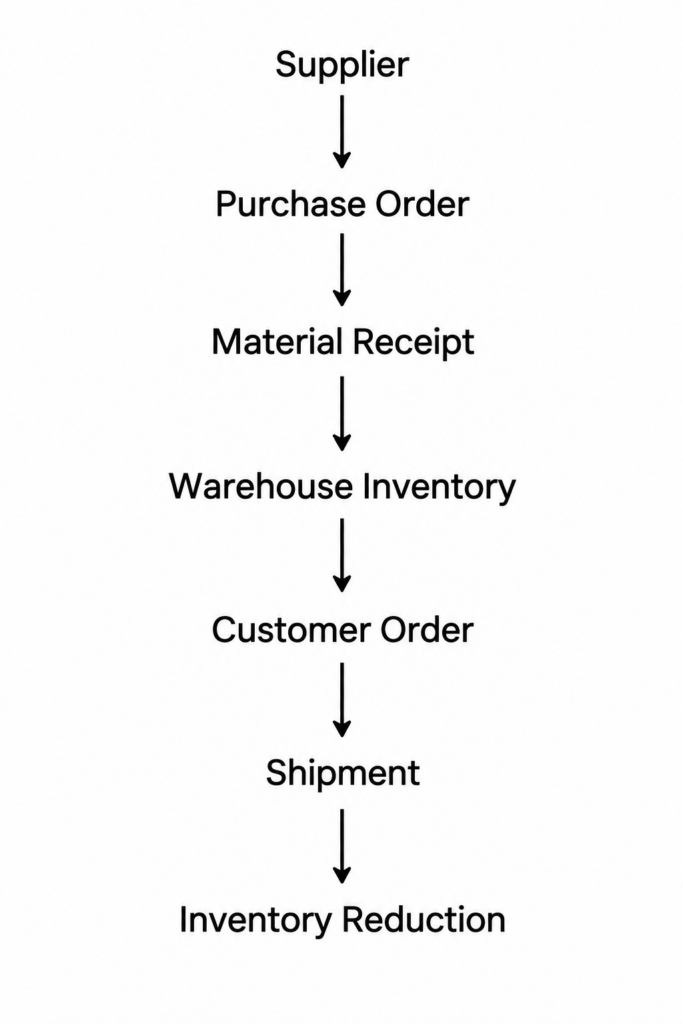
Consider a simple distribution process:
Each stage is connected within the ERP environment.
This reduces duplication of data and provides better visibility across departments.
14. Improve Inventory Traceability
Distribution companies often need to determine where inventory came from and where it went.
For example:
Maintaining transaction history allows businesses to investigate inventory movements more effectively.
This can be especially valuable when dealing with product returns, damaged goods, or inventory discrepancies.
15. Support Different Units of Measure
Distribution businesses may purchase, store, and sell products using different units.
For example:
- Supplier sells by carton
- Warehouse stores by piece
- Customer purchases by box
Maintaining consistent unit-of-measure information is important for accurate inventory control.
An ERP system can help businesses define and manage the appropriate units used throughout purchasing, inventory, and sales processes.
16. Reduce Manual Inventory Management
Spreadsheets can be useful for small operations, but they become increasingly difficult to maintain as transaction volume increases.
Manual inventory management can result in:
- Duplicate data
- Outdated stock information
- Data-entry errors
- Missing transactions
- Difficult reconciliation
- Limited visibility
Using an ERP system allows inventory transactions to be recorded as part of business processes rather than maintained in separate spreadsheets.
17. Provide Better Inventory Visibility for Management
Inventory control is also a management issue.
Business leaders need to understand:
- Which products are selling
- Which products are overstocked
- Which warehouses have shortages
- How inventory is moving
- Whether purchasing levels are appropriate
- Where working capital is tied up
Centralized ERP data can provide a foundation for inventory reporting and analysis.
Example: Inventory Control in a Distribution Company
Consider a distributor selling electrical products.
The company operates three warehouses:
| Warehouse | Product A |
|---|---|
| Chennai | 500 |
| Bangalore | 150 |
| Hyderabad | 350 |
| Total | 1,000 |
A customer in Bangalore places an order for 200 units.
Bangalore has only 150 units available.
The company can identify inventory at other warehouses and transfer 50 units from Chennai to Bangalore.
After the transfer:
| Warehouse | Product A |
|---|---|
| Chennai | 450 |
| Bangalore | 200 |
| Hyderabad | 350 |
| Total | 1,000 |
Bangalore can then fulfill the customer’s 200-unit order.
After shipment:
| Warehouse | Product A |
|---|---|
| Chennai | 450 |
| Bangalore | 0 |
| Hyderabad | 350 |
| Total | 800 |
The inventory has moved through a sequence of controlled transactions rather than being manually changed in multiple spreadsheets.
Key Benefits for Distribution Companies
Using iDempiere to manage distribution inventory can help organizations achieve:
Better Stock Visibility
Businesses can obtain a clearer view of inventory across warehouses and locations.
Improved Inventory Accuracy
Recording receipts, shipments, transfers, and adjustments as ERP transactions helps maintain more reliable inventory records.
Better Warehouse Utilization
Inventory can be redistributed between locations according to business requirements.
Improved Order Fulfillment
Sales and warehouse teams can use inventory information when planning customer shipments.
Reduced Excess Inventory
Better visibility can help businesses identify slow-moving or excess stock.
Lower Stockout Risk
Monitoring inventory levels can help organizations identify products that require replenishment.
Greater Traceability
Inventory movements can be associated with business transactions, making it easier to investigate discrepancies.
Reduced Manual Work
Integrated purchasing, sales, and inventory processes reduce dependence on separate spreadsheets and manual reconciliation.
Best Practices for Distribution Inventory Control with iDempiere
Simply implementing an ERP system does not automatically solve inventory problems. Businesses should also establish consistent inventory processes.
Maintain Accurate Product Data
Ensure that product information, units of measure, pricing, and other relevant master data are maintained consistently.
Define Warehouse and Locator Structures
Create a warehouse structure that reflects the actual physical distribution network.
Record Every Material Movement
Receipts, shipments, transfers, returns, and adjustments should be recorded promptly.
Perform Regular Physical Counts
Compare physical inventory with system quantities and investigate discrepancies.
Monitor Inventory by Warehouse
Do not rely only on company-wide inventory totals. Analyze inventory at the warehouse level.
Review Slow-Moving Products
Identify products that remain in inventory for long periods and determine whether purchasing or redistribution strategies need to change.
Establish Transfer Procedures
Define clear responsibilities for requesting, approving, shipping, and receiving inventory transfers.
Conclusion
For distribution companies, inventory control is about much more than maintaining a stock quantity. It requires accurate information about what products are available, where they are stored, what has been ordered, what has been received, what has been shipped, and how inventory moves between locations.
iDempiere can bring these activities together within an integrated ERP environment. By connecting purchasing, warehouse management, sales, shipments, inventory movements, transfers, returns, and adjustments, businesses can create a more controlled and traceable inventory process.
For growing distributors, this centralized approach can provide the visibility needed to reduce inventory errors, improve warehouse utilization, support better replenishment decisions, and fulfill customer orders more efficiently.
Ultimately, the value of iDempiere for a distribution company is not simply in tracking inventory quantities. It is in connecting inventory with the business processes that continuously change those quantities.