The PO Says 100, Receipt Says 80, Invoice Says 100 — Understanding 3-Way Matching
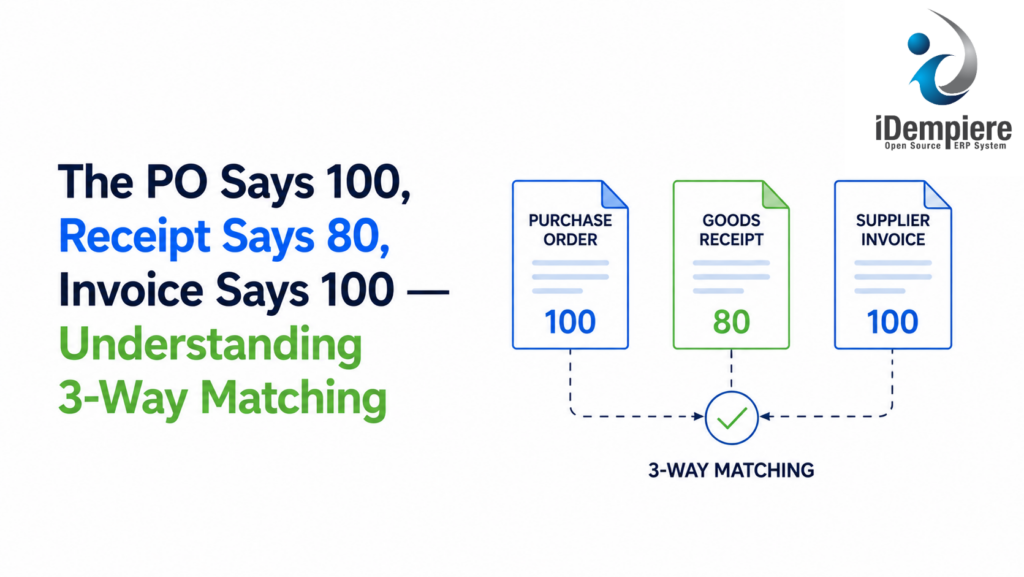
Stop overpaying for inventory. Discover how iDempiere’s built-in 3-way matching instantly catches invoice errors and delivery shortages.
When your Purchase Order, delivery receipt, and vendor invoice don’t agree, you’re either paying for goods you never received or delaying payments over paperwork mismatches. iDempiere solves this with built-in 3-way matching — a simple checkpoint that compares what you ordered, what arrived, and what you’re being billed for, before any payment goes out the door.
Why This Problem Costs Real Money
Picture this: You order 100 units from a supplier. Only 80 show up at your warehouse. But the invoice arrives billing you for all 100.
Without a system to catch this, one of three things happens:
- Accounts Payable pays the full invoice anyway, because nobody cross-checked the numbers. You just overpaid for 20 units you don’t have.
- Someone catches it manually, spends hours emailing the vendor, and the payment gets delayed — annoying your supplier and hurting your negotiating relationship.
- The mismatch slips through repeatedly, and over a year, these small leaks add up to a meaningful chunk of your procurement budget.
This is one of the most common — and most avoidable — sources of financial leakage in any business that buys goods or raw materials regularly. It doesn’t matter if you’re a manufacturer, distributor, or retailer: if you purchase inventory, this risk exists.
What 3-Way Matching Actually Means
Think of it as a built-in referee that checks three documents against each other before a payment is approved:
- The Purchase Order (PO) — what you agreed to buy, and at what price.
- The Goods Receipt — what actually arrived at your dock, confirmed by your warehouse team.
- The Vendor Invoice — what the supplier is asking you to pay.
If all three numbers line up, the system gives a green light and the invoice moves forward for payment. If they don’t line up — like our 100-vs-80 example — the system flags it and stops it from being paid automatically. A human now has to look at it, ask the vendor a question, or issue a partial payment. Nothing slips through by accident.
This isn’t a manual spreadsheet exercise your finance team has to build and maintain. It’s a standard, built-in control inside iDempiere’s purchasing and accounts payable process — the same discipline that large ERP systems have used for decades, made accessible without the enterprise price tag.
Why This Matters If You’re Evaluating a Switch
If your current system is a mix of manual invoice approvals, email chains with the warehouse team, and someone in finance eyeballing PDFs — you don’t have real matching. You have hope.
Moving to a system with real 3-way matching gives you three concrete business outcomes:
- You stop overpaying. Every invoice is checked against what was actually delivered before money leaves your account.
- Your finance team stops chasing paper. The system tells them exactly which invoices are clean and which ones need a conversation with the vendor — instead of them manually comparing three documents for every purchase.
- You get a clean audit trail. Every PO, receipt, and invoice is linked together in one record. When your accountant or auditor asks “why was this paid?”, the answer is one click away, not a search through email.
Where Companies Get Burned
After years of guiding businesses through ERP transitions, the failure pattern is always the same: companies underestimate how loosely their current process actually works. They assume “someone checks this” — but when you ask who, and how, the answer is often “nobody, formally.”
The biggest mistake during a migration is trying to replicate a broken manual process instead of adopting the built-in control. If your old system never truly matched receipts to invoices, don’t ask your new system to skip that check too, just because “that’s how we’ve always done it.” That’s exactly the gap that causes six-figure overpayments to go unnoticed for years.
The fix is simple: turn matching on from day one, train your receiving and finance teams on the new discipline, and let the system do the cross-checking your business has probably been missing all along.
Ready to Stop Guessing on What You’re Paying For?
If you’re currently relying on manual checks — or worse, no checks at all — between your purchase orders, deliveries, and invoices, it’s worth a conversation. Speak with one of our senior ERP architects for a no-pressure review of your current purchasing process, and see exactly where iDempiere would catch the leaks your current system is missing.