iDempiere ERP: A Practical Alternative to Expensive Proprietary ERP
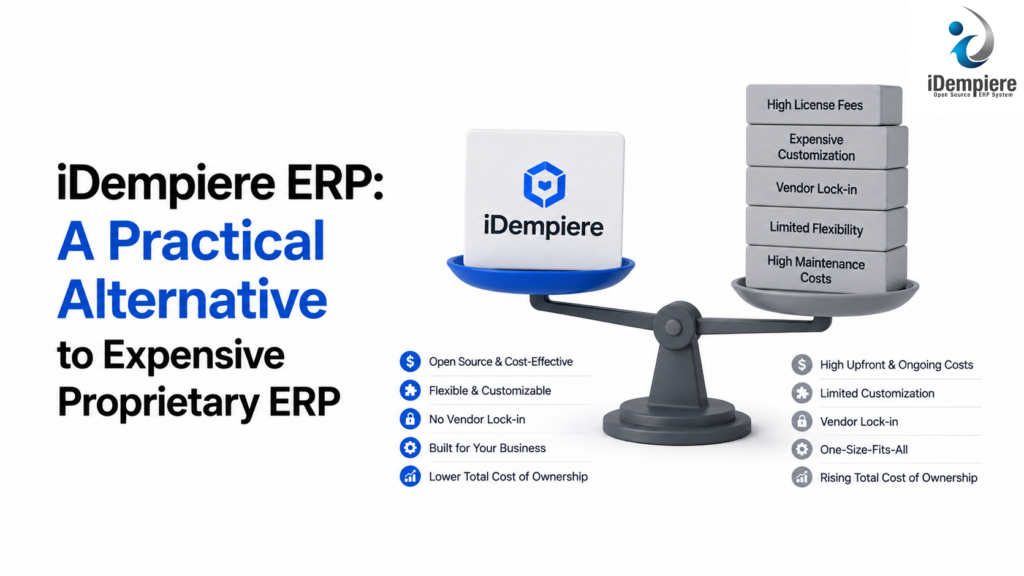
iDempiere offers an open-source alternative to proprietary ERPs, removing licensing fees to give companies complete control.
Enterprise Resource Planning (ERP) systems play a central role in managing key business operations such as finance, sales, purchasing, inventory, manufacturing, and projects. However, implementing and maintaining an ERP can become a significant long-term investment.
With proprietary ERP systems, costs often go beyond the initial software purchase. Licensing, subscriptions, implementation, customization, integrations, support, infrastructure, and upgrades can all increase the total cost of ownership. As a business grows, these costs can grow as well.
iDempiere offers one such alternative. As an open-source ERP, it gives businesses greater freedom to customize, deploy, integrate, and extend the platform according to their requirements, without relying on a traditional proprietary licensing model.
However, open-source does not mean free of cost. Businesses still need to invest in implementation, customization, infrastructure, training, support, maintenance, and upgrades.
The real question is:
Can iDempiere provide a more flexible and cost-effective ERP model while giving businesses greater control over their ERP environment?
For organizations that value flexibility, customization, and reduced vendor dependency, iDempiere can be a practical alternative to proprietary ERP.
The Cost of Proprietary ERP
The cost of a proprietary ERP system usually consists of several components rather than a single software price.
A business may initially focus on licensing or subscription fees, but the overall investment can include:
- Software licensing
- Per-user or subscription fees
- Implementation
- Configuration
- Customization
- Integration
- Infrastructure
- Support
- Maintenance
- Training
- Upgrades
- Data migration
For larger organizations, these costs can accumulate significantly over the lifetime of the ERP system.
Licensing Costs
Many proprietary ERP platforms use licensing models based on users, modules, transactions, or subscriptions. As a business grows and more employees require access, software costs can increase.
A company that starts with a limited number of users may eventually need licenses for additional departments, locations, or operational roles.
Implementation Costs
ERP implementation requires more than installing software. Business processes must be analyzed, the system must be configured, data must be migrated, users must be trained, and integrations must be established.
Implementation costs can therefore represent a significant part of the overall ERP investment.
Customization Costs
Businesses rarely operate exactly according to the standard processes provided by an ERP system.
They may require:
- Custom workflows
- Specialized reports
- Additional fields
- Business validations
- Industry-specific processes
- Custom integrations
- Additional functionality
Depending on the proprietary platform, these changes may require specialized consultants, vendor services, or additional products and licenses.
Integration Costs
Modern businesses rarely operate with a single application. ERP systems often need to communicate with:
- CRM systems
- E-commerce platforms
- Banking systems
- Payment gateways
- Payroll systems
- Manufacturing applications
- Warehouse systems
- Business intelligence platforms
These integrations introduce development, testing, maintenance, and support costs.
Upgrade and Maintenance Expenses
ERP platforms evolve over time. Businesses may need to upgrade their software to receive new functionality, security improvements, compatibility updates, or vendor support.
Upgrades can become particularly complex when an ERP has significant customizations or integrations.
Long-Term Vendor Dependency
Another cost is less obvious: dependency on the software vendor.
The organization may depend on the vendor for:
- Product updates
- Specialized expertise
- Support
- Custom functionality
- Integration solutions
- Upgrade paths
- Product roadmap decisions
This can reduce the organization’s flexibility when planning its long-term ERP strategy.
Why Businesses Look for an ERP Alternative
The increasing complexity and cost of proprietary ERP can encourage businesses to evaluate alternatives.
One major concern is Total Cost of Ownership (TCO).
An ERP may appear affordable based on its initial license price, but the long-term cost can be considerably higher once implementation, customization, integrations, infrastructure, support, and upgrades are included.
Increasing Total Cost of Ownership
As businesses grow, their ERP requirements often grow with them.
More users may require additional licenses. More departments may require additional modules. New systems may require integrations. Business-specific requirements may require customization.
The result can be an ERP environment that becomes progressively more expensive to operate.
Difficulty Scaling Licenses
A growing organization may need to provide ERP access to additional employees.
If licensing is heavily user-based, increasing the number of users can directly increase recurring software expenses.
Expensive Customization
A business may need its ERP to support processes that are not available out of the box.
When customization depends heavily on vendor-specific technologies or specialized consultants, businesses may have limited choices regarding who can maintain those customizations.
Dependence on Specialized Vendors
If only a limited number of providers have the necessary expertise to modify or maintain an ERP platform, the organization can become dependent on those providers.
This can affect:
- Cost
- Availability of technical expertise
- Negotiating power
- Implementation timelines
- Long-term planning
Limited Control
Businesses may have limited control over the underlying software, deployment model, customization approach, and product roadmap when using a proprietary ERP.
For organizations that want greater control over their technology environment, this can become an important consideration.
These challenges create an opportunity for alternative ERP approaches.
This is where iDempiere becomes relevant.
How iDempiere Provides an Alternative
iDempiere approaches ERP differently from traditional proprietary platforms.
As an open-source ERP platform, iDempiere provides organizations with access to the software source code and avoids the traditional proprietary software licensing model.
Open-Source Platform
The open-source nature of iDempiere allows organizations and qualified technical teams to examine and modify the software.
This can be valuable when standard ERP functionality does not fully meet business requirements.
No Traditional Proprietary Software License Fee
One of the major differences is that organizations do not have to purchase traditional proprietary software licenses to use the platform.
This can remove a significant category of ERP expenditure.
However, businesses still need to invest in implementation, infrastructure, customization, support, and maintenance.
Access to Source Code
Access to source code provides greater technical control.
Organizations can work with internal developers or implementation partners to:
- Modify functionality
- Build extensions
- Develop integrations
- Create custom processes
- Implement specialized requirements
Flexible Deployment
Businesses can choose an infrastructure model that fits their requirements.
Depending on their circumstances, they may consider:
- On-premises infrastructure
- Private infrastructure
- Cloud infrastructure
- Managed hosting
- Partner-managed environments
Customizable Business Processes
Every organization has different workflows and operational requirements.
iDempiere can be extended to support business-specific processes rather than requiring every organization to operate exactly according to a predefined proprietary model.
Extensible Architecture
The platform can be extended as business requirements change.
This means an organization can start with its immediate ERP requirements and add functionality as its operations become more complex.
Implementation Partners
Open-source does not mean that businesses must implement the ERP alone.Organizations can work with experienced implementation partners for:
- ERP implementation
- Configuration
- Custom development
- Integration
- Data migration
- Training
- Support
- Maintenance
This creates an ecosystem in which the business can select technical expertise according to its requirements.
iDempiere vs. Proprietary ERP: Cost Structure
A useful way to compare iDempiere with proprietary ERP is to examine where the costs come from.
| Cost Area | Proprietary ERP | iDempiere |
|---|---|---|
| Software licensing | Often significant | No traditional proprietary license fee |
| User licensing | May increase with users | Not based on proprietary per-user licensing |
| Implementation | Required | Required |
| Customization | May be costly | Flexible/customizable |
| Integration | May require vendor-specific solutions | Flexible |
| Hosting | Depends on vendor/deployment | Flexible deployment options |
| Support | Often vendor/partner based | Partner/community options |
| Upgrades | Often vendor-controlled | Managed by organization/implementation partner |
The important point is that iDempiere does not eliminate ERP expenditure.
Instead, it can eliminate or reduce certain proprietary licensing costs while giving the business more control over other areas of the ERP investment.
For example, a business may spend money on implementation and customization regardless of which ERP it selects. The difference is how those investments are structured and who controls them
Total Cost of Ownership: iDempiere vs. Proprietary ERP
Licensing is only one part of ERP economics.
A more useful comparison is Total Cost of Ownership.
Proprietary ERP TCO
A simplified model can be represented as:
Licensing + Implementation + Customization + Integration + Support + Upgrades + Infrastructure
iDempiere TCO
A simplified model can be represented as:
Implementation + Customization + Integration + Infrastructure + Support + Maintenance
The two models are not completely different because both require significant implementation and ongoing management.
The major difference is that iDempiere does not rely on a traditional proprietary software licensing model.
What Determines the Actual TCO?
The actual cost of an iDempiere implementation depends on several factors.
Number of Users
Although iDempiere does not follow a traditional proprietary per-user licensing model, more users can still increase infrastructure, training, support, and operational requirements.
Business Complexity
A simple trading business and a complex manufacturing organization will have very different implementation requirements.
Customization Requirements
The more specialized the business processes, the greater the potential development and maintenance effort.
Infrastructure
The chosen hosting and infrastructure model affects ongoing costs.
Implementation Partner
The experience, scope, and pricing of the implementation partner can have a significant impact on the project cost.
Internal Technical Capabilities
Organizations with capable internal IT and development teams may be able to manage more of the platform themselves.
Businesses without those capabilities may require greater external support.
Support Requirements
Some organizations may need extensive managed support, while others may have internal teams capable of handling routine administration and maintenance.
Therefore, it is more accurate to say that iDempiere can reduce certain categories of ERP cost, rather than simply calling it a low-cost or free ERP.
Customization Without Being Locked Into a Proprietary Platform
One of the most important advantages of an ERP platform is the ability to adapt it to the organization’s business processes.
No two businesses operate exactly the same way.
A company may require unique approval processes, specialized reporting, industry-specific workflows, or integrations with existing applications.
Business Process Customization
Organizations may need ERP processes to reflect their actual operating model.
Customization can support requirements such as:
- Approval workflows
- Business validations
- Document processes
- Automated actions
- Organization-specific rules
Custom Fields
Businesses may need information that is not included in the standard ERP configuration.
Custom fields can help capture additional business information without forcing the organization to change its operational process simply to fit the software.
Custom Reports
Organizations often require reports designed around their specific management and operational requirements.
Custom Integrations
iDempiere can be integrated with external systems to create a broader business application environment.
Extensions
When standard functionality is not enough, organizations can develop extensions to address specialized requirements.
The important distinction is that businesses have greater freedom to decide how and by whom these changes are implemented.
Instead of being completely dependent on the original software vendor, an organization can work with its own technical team or an implementation partner
Reducing ERP Vendor Lock-In
Vendor lock-in occurs when it becomes difficult or expensive for an organization to change its software provider, implementation partner, or technology environment.
This can happen when a business becomes heavily dependent on:
- Proprietary technologies
- Vendor-specific customizations
- Vendor-controlled integrations
- Vendor-specific expertise
- Proprietary licensing agreements
iDempiere can help reduce this dependency by giving organizations greater control over the ERP platform.
Source Code
Access to source code means the organization is not dependent solely on the original software vendor to understand or modify the platform.
Data
The business maintains control over its ERP data and can design its infrastructure and integration strategy around its own requirements.
Customizations
Custom functionality can be maintained and extended by qualified developers rather than being exclusively tied to the original vendor.
Deployment
The organization can choose where and how the ERP is deployed.
Implementation Partners
Businesses can work with different technical partners when their requirements or strategic relationships change.
This does not mean that iDempiere completely eliminates dependency.
Businesses can still become dependent on a particular implementation partner if they fail to maintain documentation, technical knowledge, or internal capabilities.
The objective is therefore not zero dependency, but greater control and more choices.
Flexible Deployment and Infrastructure
Another important consideration is where and how the ERP operates.
Different organizations have different infrastructure requirements.
Some businesses may prefer to maintain their systems internally, while others may prefer managed hosting or cloud infrastructure.
iDempiere provides flexibility in deployment.
On-Premises Deployment
Organizations with their own infrastructure and technical teams can operate the ERP within their own environment.
This can provide direct control over infrastructure and system administration.
Private Infrastructure
Businesses may use dedicated infrastructure managed either internally or by a service provider.
Cloud Infrastructure
Organizations can deploy iDempiere on cloud infrastructure according to their operational requirements.
Managed Hosting
Businesses that do not want to manage the entire technical environment internally can work with hosting or implementation partners.
The key advantage is choice.
The business can select an infrastructure model based on cost, security, performance, internal expertise, and operational requirements rather than being restricted to a single deployment model.
When iDempiere Makes Practical Business Sense
iDempiere is not necessarily the right choice for every organization.
It becomes particularly interesting when a business has specific requirements around cost, flexibility, customization, and control.
iDempiere may be worth considering when a business:
- Wants greater control over ERP licensing costs
- Requires significant customization
- Has business processes that do not fit standard ERP workflows
- Wants greater control over its ERP environment
- Wants to reduce vendor dependency
- Needs flexible deployment options
- Requires integrations with multiple systems
- Has an internal technical team
- Has access to an experienced implementation partner
- Expects ERP requirements to change over time
- Wants to extend its ERP rather than replace it frequently
The strongest fit is often an organization that values control and flexibility alongside cost management.
iDempiere vs. Proprietary ERP: Practical Decision Framework
Businesses can evaluate iDempiere based on their specific requirements rather than simply comparing software prices.
| Business Requirement | Consider iDempiere When… |
|---|---|
| Cost control | Licensing cost is a major concern |
| Customization | Standard ERP processes do not fit the business |
| Vendor independence | The business wants greater control over the ERP platform |
| Deployment | The business wants flexible deployment options |
| Integration | Multiple systems need to be integrated |
| Long-term flexibility | ERP requirements are expected to change |
| Technical capability | Internal or partner technical expertise is available |
| Business growth | The ERP needs to expand with changing requirements |
This framework helps shift the evaluation from “Which ERP is cheaper?” to “Which ERP model best fits our business?”
That is a more useful question because the lowest software price does not automatically result in the lowest long-term cost.
Our iDempiere Services: From Implementation to Ongoing Support
Dempiere can be a practical ERP option for organizations looking for an open-source platform that can be adapted to their business requirements.
However, choosing an ERP is only the beginning. Successful ERP adoption also depends on implementation, configuration, customization, integration, training, infrastructure, support, and ongoing maintenance.
This is where our iDempiere services can help.
We can help businesses implement and adapt iDempiere according to their operational requirements, from initial setup and configuration through customization, integration, deployment, and ongoing support.
Our iDempiere services can include:
- iDempiere Implementation – Setting up and configuring iDempiere according to business processes and operational requirements.
- Customization and Development – Extending standard functionality with custom workflows, fields, reports, validations, and business-specific processes.
- System Integration – Connecting iDempiere with CRM, e-commerce, banking, payment, manufacturing, warehouse, and other business applications where required.
- Data Migration – Supporting the preparation, transformation, and migration of existing business data into iDempiere.
- Deployment and Infrastructure – Helping organizations select and set up an appropriate deployment environment based on their technical and operational requirements.
- Training – Helping users understand the system and adopt ERP processes effectively.
- Support and Maintenance – Providing ongoing technical assistance, system maintenance, troubleshooting, and updates.
- Upgrades and Enhancements – Helping organizations evaluate and implement future iDempiere updates and extend the system as their business requirements evolve.
We help organizations determine whether iDempiere fits their requirements and, where it does, provide the technical expertise needed to implement and maintain it effectively.
For businesses considering an open-source ERP, iDempiere provides a flexible platform, while our services can provide the implementation, customization, integration, and ongoing technical support needed to turn that platform into an ERP solution aligned with their business processes.