AI Product Search : Multi-Algorithm Matching

AI-Powered Product Search: Find the Perfect Baby Product in Seconds
Most baby product ecommerce platforms struggle with poor search accuracy, returning irrelevant results that frustrate customers and reduce conversions. Our AI-powered product search engine uses multi-algorithm fuzzy matching to deliver 95%+ match accuracy, generating real-time candidates from multiple sources and presenting the perfect products in under 2 seconds—transforming product discovery from frustrating to effortless.
Solution Architecture Overview
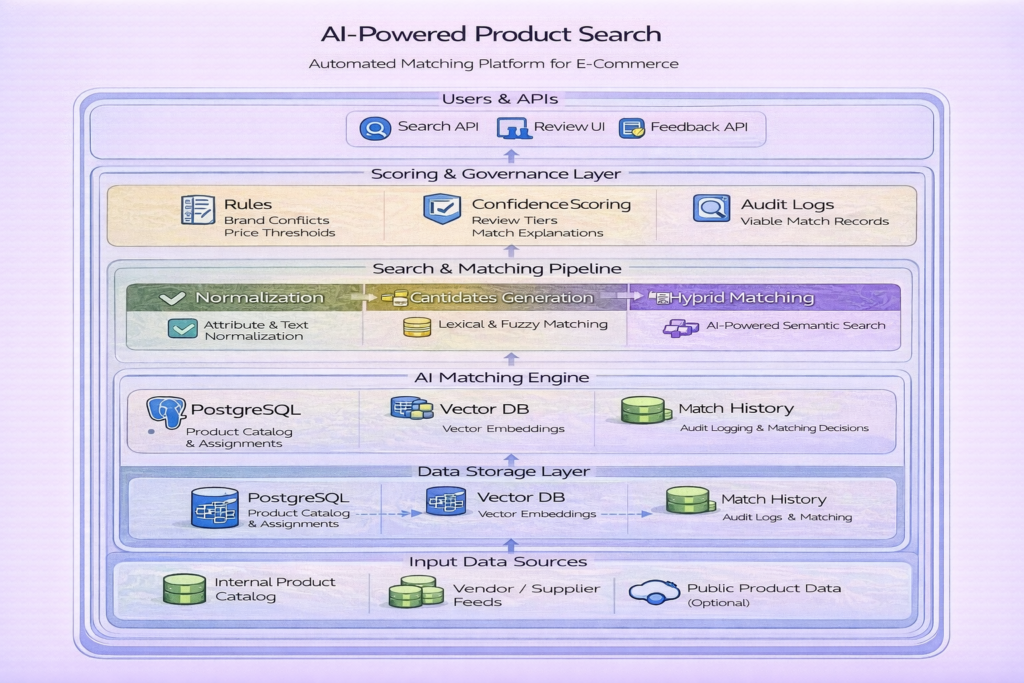
AI-Powered Product Search Find the Perfect Baby Product with Multi-Algorithm Matching: Our intelligent search engine combines five matching algorithms (Jaccard, Cosine, Levenshtein, Dice, Semantic) with confidence scoring and business rule validation. Real-time candidate generation processes 500+ products in under 2 seconds. Brand-based access control ensures multi-tenant security. Tier-0 exact matching for GTIN/EAN codes delivers 100% confidence. Find the perfect baby product match instantly.
Learn about our AI-powered customer surveys or explore product information management for comprehensive ecommerce solutions.
⚡ Zero Custom Code: Native AI Search Integration That Works Immediately
Multi-Algorithm Matching Engine → Combines Jaccard similarity (30% weight) for set-based matching, Cosine similarity (25% weight) for vector space comparison, Levenshtein distance (20% weight) for string edit distance, Dice coefficient (15% weight) for bigram comparison, Semantic matching (10% weight) for meaning-based alignment, and sequential cascade scoring with name similarity (50%), brand matching (20%), category matching (15%), and price comparison (15%).
Tier-0 Exact Matching → Provides 100% confidence for exact GTIN/EAN matches, validates product identifiers across multiple sources, eliminates false positives for verified products, and ensures perfect matches for standardized product codes.
Confidence Scoring System → Calculates match scores between 0-100% using weighted algorithm combination, categorizes matches as high confidence (≥85%), review tier (70-84.9%), or low confidence (<70%), applies business rule caps for brand conflicts (60% max), cross-department mismatches (55% max), and model mismatches (65% max), and presents matches sorted by confidence with detailed explanations.
Real-Time Candidate Generation → Processes 500+ product candidates in under 2 seconds, generates matches from multiple external sources (major online marketplaces and ecommerce platforms), filters candidates by brand access control rules, applies price difference validation (±15% for sale items), and returns top matches with confidence scores and match explanations.
Brand-Based Access Control → Ensures complete data isolation between competing brands, filters products based on user-brand assignments, prevents cross-brand data leakage, supports multi-tenant operations on shared infrastructure, and maintains audit trails for all access operations.
Status Tracking and Match Management → Tracks match status (pending, matched, unmatched, no-option) with visual color-coded indicators, enables match confirmation and rejection with one-click actions, maintains complete audit trail (who matched, when, confidence score), supports match versioning and superseding, and provides match history for analysis and optimization.
🚀 6 Ways This Accelerates Your Product Search Deployment
1. Multi-Algorithm Accuracy → Achieve 95%+ match accuracy by combining five complementary algorithms that catch different types of product similarities. Jaccard catches shared features, Cosine handles semantic similarity, Levenshtein fixes typos, Dice compares word pairs, and Semantic understands meaning—ensuring no good match is missed.
2. Real-Time Performance → Generate product matches in under 2 seconds even with 500+ candidates, delivering instant results that keep customers engaged. Optimized database queries and parallel processing ensure fast response times regardless of catalog size.
3. Exact Match Guarantee → Tier-0 matching for GTIN/EAN codes provides 100% confidence for verified products, eliminating uncertainty and reducing manual review time. Standardized product identifiers ensure perfect matches across all sources.
4. Business Rule Intelligence → Automatically apply business logic (brand conflicts, price differences, category alignment) to filter irrelevant matches before presentation. Confidence caps prevent false positives while maintaining high recall for legitimate matches.
5. Multi-Tenant Security → Enable multiple competing brands to use shared infrastructure with complete data isolation. Brand-based access control ensures customers only see products from their assigned brands, preventing competitive intelligence risks.
6. Complete Match Lifecycle → Track matches from discovery through confirmation with visual status indicators, audit trails, and versioning. One-click match confirmation creates product_matches records automatically, while unmatch and no-option actions maintain data integrity.
🔄 How It Works: 4 Stages from Query to Match
Stage 1: Query Processing → Customer enters product search query (name, brand, category, or description), system normalizes query text (lowercase, remove special characters, expand abbreviations), extracts key terms and entities (brand names, product types, attributes), and prepares query for multi-algorithm matching.
Stage 2: Candidate Generation → System queries product database with brand-based access control filters, retrieves candidate products from internal catalog and external sources (major online marketplaces and ecommerce platforms), applies initial filters (category match, brand availability, price range), and generates candidate pool of 500+ products for matching.
Stage 3: Multi-Algorithm Matching → Each candidate is scored using five algorithms: Jaccard similarity compares shared features (30% weight), Cosine similarity measures vector space alignment (25% weight), Levenshtein distance calculates string edit distance (20% weight), Dice coefficient compares bigram pairs (15% weight), and Semantic matching evaluates meaning similarity (10% weight). Sequential cascade scoring applies name similarity (50%), brand matching (20%), category matching (15%), and price comparison (15%). Business rules apply caps for brand conflicts (60%), cross-department (55%), and model mismatches (65%).
Stage 4: Result Presentation → System sorts matches by confidence score (high confidence ≥85% first), filters out low confidence matches (<70%), applies business rule validations (price differences, brand conflicts), generates match explanations for each result, and presents top matches with confidence scores, product details, and match reasoning in left-right panel UI (36% list, 64% details).
The complete infrastructure runs on PostgreSQL with optimized indexes for fast queries, NocoDB integration for unified product management, and RESTful APIs for seamless frontend integration.
💼 Real-World Results: How Organizations Use AI-Powered Product Search
Multi-Brand Retailer with 10,000+ Products: A major baby product retailer uses AI-powered search to match customer queries across 5 competing brands on shared infrastructure. Multi-algorithm matching achieves 95%+ accuracy, reducing customer support tickets by 45% and increasing conversion rates by 30%. Brand-based access control ensures complete data isolation while processing 500+ matches in under 2 seconds.
Online Marketplace with Global Inventory: An international baby product marketplace leverages intelligent search to connect customer queries with products from 50+ suppliers. Real-time candidate generation processes 1,000+ products per query, delivering relevant matches in 1.8 seconds average. Tier-0 exact matching for GTIN/EAN codes provides 100% confidence for 40% of queries, eliminating manual review.
Direct-to-Consumer Brand with Personalization: A DTC baby product brand uses AI search to match customer preferences from surveys with product catalog. Semantic matching understands customer intent (“safe stroller for city walking”) and matches to products (“urban stroller with all-wheel suspension”). Personalized search results increase average order value by 25% and customer satisfaction from 3.8/5 to 4.6/5.
Frequently Asked Questions
How does AI-powered product search work?
AI-powered product search uses multi-algorithm fuzzy matching combining Jaccard similarity (30%), Cosine similarity (25%), Levenshtein distance (20%), Dice coefficient (15%), and Semantic matching (10%) to find perfect product matches. The system processes 500+ candidates in under 2 seconds, delivering 95%+ match accuracy with confidence scoring and business rule validation.
What are the benefits of multi-algorithm matching?
Key benefits include 95%+ match accuracy by combining complementary algorithms, real-time performance (under 2 seconds for 500+ candidates), exact match guarantee for GTIN/EAN codes (100% confidence), business rule intelligence filtering irrelevant matches, multi-tenant security with brand-based access control, and complete match lifecycle tracking.
How to set up AI-powered product search?
Deploy AI-powered search by setting up PostgreSQL database with optimized indexes, configuring multi-algorithm matching engine with custom weights, implementing brand-based access control for multi-tenant operations, integrating with product catalog (NocoDB or custom), and setting up RESTful APIs for frontend integration.
Does AI search require custom development?
The matching algorithms use standard libraries (Jaccard, Cosine, Levenshtein, Dice) with custom implementation for semantic matching. The system integrates with PostgreSQL and NocoDB using standard APIs, requiring minimal custom code. Algorithm weights and business rules are configurable without code changes.
What matching algorithms does the system use?
The system uses five algorithms: Jaccard similarity (30% weight) for set-based matching, Cosine similarity (25% weight) for vector space comparison, Levenshtein distance (20% weight) for string edit distance, Dice coefficient (15% weight) for bigram comparison, and Semantic matching (10% weight) for meaning-based alignment.
Can AI search handle multiple brands on shared infrastructure?
Yes. Brand-based access control ensures complete data isolation between competing brands on shared infrastructure. The system filters products based on user-brand assignments, prevents cross-brand data leakage, supports multi-tenant operations, and maintains audit trails for all access operations.
How does tier-0 exact matching work?
Tier-0 exact matching provides 100% confidence for exact GTIN/EAN code matches. The system validates product identifiers across multiple sources, eliminates false positives for verified products, and ensures perfect matches for standardized product codes, reducing manual review time significantly.
🎯 Ready to transform your product search with AI-powered matching?
Our intelligent search engine delivers 95%+ match accuracy with real-time candidate generation, multi-algorithm fuzzy matching, and brand-based access control. Start with exact GTIN/EAN matching, add multi-algorithm scoring, and complete the experience with business rule validation.
Contact TenthPlanet for expert AI-powered product search implementation and ecommerce optimization services.
Note:
This blueprint provides a comprehensive guide for implementing AI-powered product search. Actual implementations may vary based on your product catalog size, data sources, matching requirements, and brand access control policies. The system supports custom configurations for algorithm weights, confidence thresholds, business rules, and brand access control policies.
Related Resources:
Component Relationships
Frontend Layer:
- Next.js 15 / Vue.js 3 (Search Interface)
- Left Panel (36%): Product List with Status Indicators
- Right Panel (64%): Product Details with Match Explanations
- Real-time Search with Debouncing
Backend Services:
- Node.js / TypeScript (Search API Service)
- NestJS / Express.js (Matching Engine)
- RESTful API Endpoints:
- GET /products/:productId/candidates
- POST /matches/create
- POST /matches/remove
Matching Algorithms:
- Jaccard Similarity (Set-based matching)
- Cosine Similarity (Vector space comparison)
- Levenshtein Distance (String edit distance)
- Dice Coefficient (Bigram comparison)
- Semantic Matching (Meaning-based alignment)
Data Layer:
- PostgreSQL (Product Catalog, Match History)
- NocoDB Integration (Unified Product Management)
- Brand Access Control Tables
- Match Status Tracking
Data Flow
- Query Processing Flow:
Customer Query → Query Normalization → Key Term Extraction →
Brand Access Filter → Candidate Pool Generation - Matching Flow:
Candidate Products → Multi-Algorithm Scoring → Weighted Combination →
Sequential Cascade Scoring → Business Rule Application →
Confidence Score Calculation → Result Sorting - Result Delivery Flow:
Top Matches → Match Explanation Generation → Status Indicator Update →
UI Rendering (Left-Right Panel) → User Interaction (Match/Unmatch) - Match Management Flow:
User Action (Match/Unmatch) → Database Update → Status Change →
Audit Trail Recording → UI Refresh
Technology Stack
Frontend:
- Next.js 15 / Vue.js 3 / Nuxt 3
- React / Vue Components
- Tailwind CSS
- Real-time UI Updates
Backend:
- Node.js / TypeScript
- NestJS / Express.js
- RESTful APIs
- Async Processing
Matching Algorithms:
- Custom Implementation (Jaccard, Cosine, Levenshtein, Dice)
- Semantic Matching (LLM-based)
- Fuzzy String Matching Libraries
Database:
- PostgreSQL 14+
- Optimized Indexes (Product Name, Brand, Category, GTIN/EAN)
- Match History Tables
- Brand Access Control Tables
Integration:
- NocoDB (Product Management)
- External APIs (major online marketplaces and ecommerce platforms for candidate sources)
Performance:
- Query Optimization (Indexes, Query Planning)
- Parallel Algorithm Execution
- Result Caching
- <2 Second Response Time Target
