Data Science Use-Cases for Large Industries
Data Science has wide-ranging applications across industries, from healthcare and education to transportation and manufacturing. Organizations use Pentaho 10.2 Data Science capabilities to boost production, make smarter decisions, and develop innovative products tailored to customer needs.
Learn about Pentaho data science integration or explore Pentaho and R integration for comprehensive analytics solutions.
Pentaho 10.2 Solution Architecture for Data Science Use Cases
Architecture Overview
Pentaho 10.2’s unified platform provides comprehensive data science capabilities from data preparation through model deployment to actionable insights.
Solution Architecture Blueprint
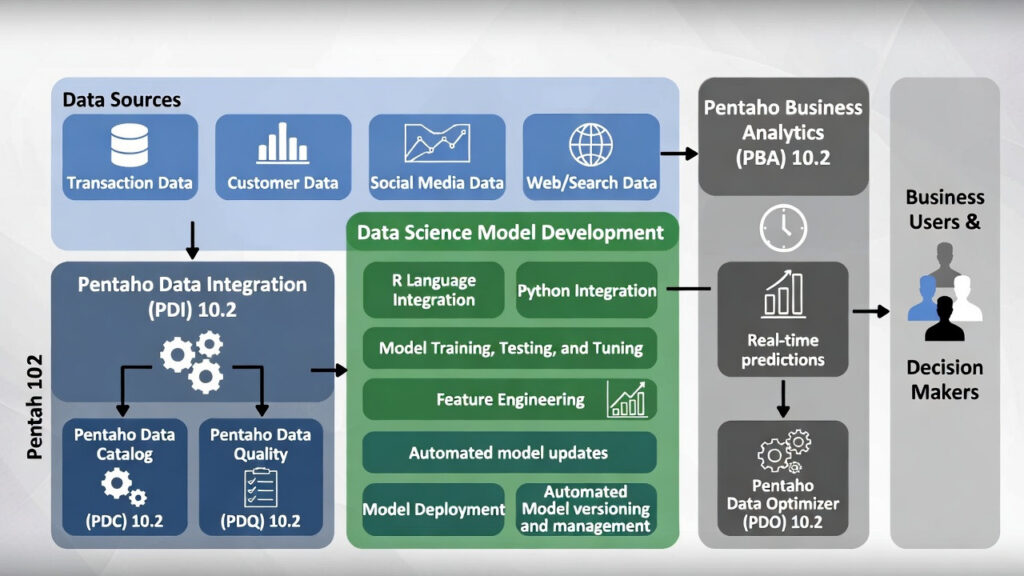
- Customer insights: Understand customer behavior and preferences
- Risk management: Identify and mitigate business risks
- Quality assurance: Improve product and service quality
- Operational efficiency: Optimize processes and reduce costs
| Use Case | Industries Applicable |
| Up Selling and Cross Selling | Banking, Insurance, Retail, Telecommunications |
| Sentiment Analysis | Life Sciences, Education, Insurance, Retail, Telecommunications |
| Risk Modelling | Automotive, Banking, Manufacturing, Logistics & Transportation, Oil & Gas, Utilities |
| Quality Assurance | Automotive, Life Sciences, Manufacturing, Logistics & Transportation, Oil & Gas, Utilities |
| Propensity Modelling | Banking, Insurance, Retail |
| Predictive Modelling/Maintenance | Automotive, Manufacturing, Logistics & Transportation, Oil & Gas, Utilities |
| Customer Segmentation | Automotive, Banking, Life Sciences, Insurance, Retail, Telecommunications, Utilities |
| Next Best Action (Recommendation Systems) | Banking, Education, Insurance, Telecommunications |
| Customer Lifetime Value | Banking, Insurance, Retail, Telecommunications, Utilities |
| Churn Prevention | Automotive, Banking, Insurance, Retail, Telecommunications |
Up Selling and Cross Selling
Predictive analytics can provide suggestions on which products might be combined to appeal to which market segments, to increase both your value to your customers, and the revenue derived from your customers.
Sentiment Analysis
Combining web search and crawling tools with customer feedback and posts, you can create analytics that give you a picture of your organization’s reputation within your key markets and demographics, and provide you with proactive recommendations as to the best ways to enhance that reputation.
Pentaho 10.2 makes this easier. Data Integration collects data from multiple sources including web, social media, and customer feedback. Python integration enables natural language processing for sentiment analysis. AI/ML-powered anomaly detection identifies sentiment trends automatically. Business Analytics creates dashboards showing sentiment scores and trends over time.
Risk Modelling
Predictive analytics can glean potential areas of risk from the massive number of data points collected by most organizations, and sorting through them to identify potential areas of risk, and trends in the data that suggest the development of situations that can affect the business and bottom line. By combining these analytics with a cogent risk management approach, companies can capture and quantify risk issues, evaluate them, and decide on a course of action to mitigate those risk factors deemed most critical.
Pentaho 10.2 handles massive datasets efficiently with Java 17’s 2-3x performance improvement. R and Python integrations enable building sophisticated risk models. AI/ML-powered anomaly detection identifies unusual patterns that may indicate risk. Continuous real-time monitoring alerts when risk indicators exceed thresholds. Automated policy creation ensures compliance with risk management frameworks.
Quality Assurance
Quality control is key to not just the customer experience, but also to your bottom line and operational expenses as well. Over time, inefficient quality control will affect your customer satisfaction, buying behaviors, and ultimately impact revenues and market share. Good predictive analytics, however, can provide insight into potential quality issues and trends before they become truly critical issues.
Pentaho 10.2’s Data Quality component changes this. 250+ predefined quality rules validate data automatically. AI/ML-powered anomaly detection identifies quality issues before they become critical. One-click instant profiling provides immediate insights into data quality patterns. Continuous real-time monitoring alerts when quality metrics deviate. Automated issue resolution fixes common quality problems automatically.
Propensity Modelling
Propensity models are often used to identify those most likely to respond to an offer, or to focus retention activity on those most likely to churn. The model may be applied to your database to score all your customers or prospects. You can then select only those who are most likely to exhibit the predicted behavior, for example response, and focus your mailing activity appropriately.
R and Python integrations in Pentaho 10.2 enable building sophisticated propensity models. The platform’s orchestration capabilities allow models to be deployed directly into operational workflows. Data Integration processes customer databases efficiently. Business Analytics creates dashboards showing propensity scores and segmentation results.
Predictive Modelling/Maintenance
By analyzing metrics and data related to the life-cycle maintenance of technical equipment, companies can predict both timelines for probable maintenance events and upcoming capital expenditure requirements, allowing them to streamline their maintenance costs and avoid critical downtime.
Pentaho 10.2 streamlines this process. Data Integration collects maintenance data from multiple sources. R and Python integrations enable building predictive maintenance models. AI/ML-powered anomaly detection identifies equipment anomalies that may indicate maintenance needs. Continuous real-time monitoring tracks equipment performance metrics. Business Analytics creates dashboards showing maintenance predictions and schedules.
Customer Segmentation
Customer segmentation involves grouping customers into specific marketing groups, perhaps narrowing them down by gender, interests, buying habits or demographic. The process requires a thought-out strategy, understanding how to manage and group your customers and which data you will use to do this. By differentiating their customer base, businesses can better target individuals and maximize sales, link-sell appropriately and provide more tailored shopping experiences.
Pentaho 10.2 simplifies segmentation. Data Integration prepares and blends customer data from multiple sources. R and Python integrations enable sophisticated clustering algorithms for segmentation. AI/ML-powered analytics identifies natural customer segments. Data Catalog’s ML-driven business glossary connects technical data to business segments. Business Analytics creates interactive dashboards for exploring customer segments.
Next Best Action (Recommendation Systems)
Defining your primary market segments and customers is a critical use case for predictive analytics. But that only provides an incomplete picture of what your marketing approach should be. Analytics can also provide insight on the best way to approach individual customers within those segments, by analyzing everything from buying patterns to consumer behavior to social media interactions, giving you insight into the best times and channels to connect to those customers.
Pentaho 10.2 integrates data from multiple sources including buying patterns, behavior, and social media. R and Python integrations enable building recommendation models. AI/ML-powered analytics provides real-time next best action recommendations. Business Analytics creates dashboards showing recommendation scores and customer engagement opportunities.
Customer Lifetime Value
One of the more difficult things to do in marketing is to identify those customers that are going to spend the most money, in the most consistent way and over the longest period of time. This kind of insight allows companies to optimize their marketing to increase their share of that segment of the business, and gain those customers that will have the greatest lifetime value to your company.
Pentaho 10.2 makes this more achievable. Data Integration processes historical customer transaction data efficiently. R and Python integrations enable building sophisticated lifetime value models. AI/ML-powered analytics identifies high-value customer segments. Business Analytics creates dashboards showing lifetime value scores and trends. The platform’s orchestration capabilities enable automated model updates as new data arrives.
Churn Prevention
Customer churn occurs when customers or subscribers stop doing business with a company or service. Also known as customer attrition, customer churn is a critical metric because it is much less expensive to retain existing customers than it is to acquire new customers – earning business from new customers means working leads all the way through the sales funnel, utilising your marketing and sales resources throughout the process. Customer retention, on the other hand, is generally more cost-effective as you’ve already earned the trust and loyalty of existing customers.
Pentaho 10.2 helps prevent churn proactively. Data Integration collects customer interaction data from multiple touchpoints. R and Python integrations enable building churn prediction models. AI/ML-powered anomaly detection identifies customers showing early churn indicators. Continuous real-time monitoring tracks customer engagement metrics. Business Analytics creates dashboards showing churn risk scores and retention opportunities. Automated workflows can trigger retention campaigns for high-risk customers.
Key Benefits of Pentaho 10.2 for Data Science Use Cases
- Integrated Data Science: R and Python integrations enable building sophisticated models without separate tools
- Faster Processing: Java 17 provides 2-3x faster data processing, reducing time to prepare data and train models
- Data Quality Assurance: 250+ quality rules and AI/ML anomaly detection ensure model inputs are accurate
- Automated Orchestration: Seamless orchestration from data preparation through model deployment
- Real-Time Predictions: Models operationalized in PDI provide real-time predictions as data flows
- Self-Service Analytics: Business users can explore model results without IT assistance
- Complete Lineage: Open Lineage tracking provides complete audit trail from data sources to predictions
- Automated Model Updates: Pre-built workflows automatically update models with new data
Frequently Asked Questions
What data science use cases does Pentaho support?
Pentaho 10.2 supports data science use cases across industries including healthcare (patient outcome prediction, disease diagnosis), education (student performance analysis, personalized learning), transportation (route optimization, demand forecasting), manufacturing (predictive maintenance, quality control), and many other industry-specific applications.
How does Pentaho enable predictive analytics?
Pentaho enables predictive analytics through integrated R and Python tools for building sophisticated models, faster data processing (2-3x with Java 17), automated orchestration from data preparation through model deployment, real-time predictions, and automated model updates with new data.
What industries benefit from Pentaho data science?
Industries benefiting from Pentaho data science include healthcare, education, transportation, manufacturing, retail, finance, energy, and many others. Pentaho’s flexible architecture and integrated data science tools enable organizations across industries to build predictive models and make data-driven decisions.
How does Pentaho ensure data quality for data science?
Pentaho ensures data quality for data science through 250+ predefined quality rules, AI/ML-powered anomaly detection, integrated data quality validation ensuring model inputs are accurate, and complete lineage tracking providing audit trails from data sources to predictions.
Can Pentaho operationalize data science models?
Yes. Pentaho enables operationalization of data science models directly into operational workflows. Models operationalized in PDI provide real-time predictions as data flows, with automated model updates and complete lineage tracking from data sources to predictions.
What are the benefits of Pentaho for industry data science?
Key benefits include integrated data science tools (R and Python), faster processing (2-3x improvement), data quality assurance, automated orchestration, real-time predictions, self-service analytics for business users, complete lineage tracking, and automated model updates.
How does Pentaho support self-service analytics for data science?
Pentaho supports self-service analytics through PBA’s self-service reporting and dashboards, enabling business users to explore model results without IT assistance. Intelligent query caching provides instant insights, and business users can create their own reports from data science model outputs.
🎯 Ready to implement data science use cases?
Pentaho 10.2 Data Science capabilities enable organizations across industries to boost production, make smarter decisions, and develop innovative products tailored to customer needs. Learn how Pentaho can transform your industry data into predictive analytics and operational efficiency.
Contact TenthPlanet for expert Pentaho data science implementation and industry-specific analytics services.
Note: This guide provides a comprehensive overview of data science use cases with Pentaho 10.2. Actual implementations may vary based on specific industry requirements, data sources, and analytical needs.
Related Resources:
