From Customer Order to Payment: The Complete Sales Cycle in iDempiere
Automate your entire sales cycle. See how iDempiere ERP connects orders, delivery, and invoicing to eliminate manual data entry.
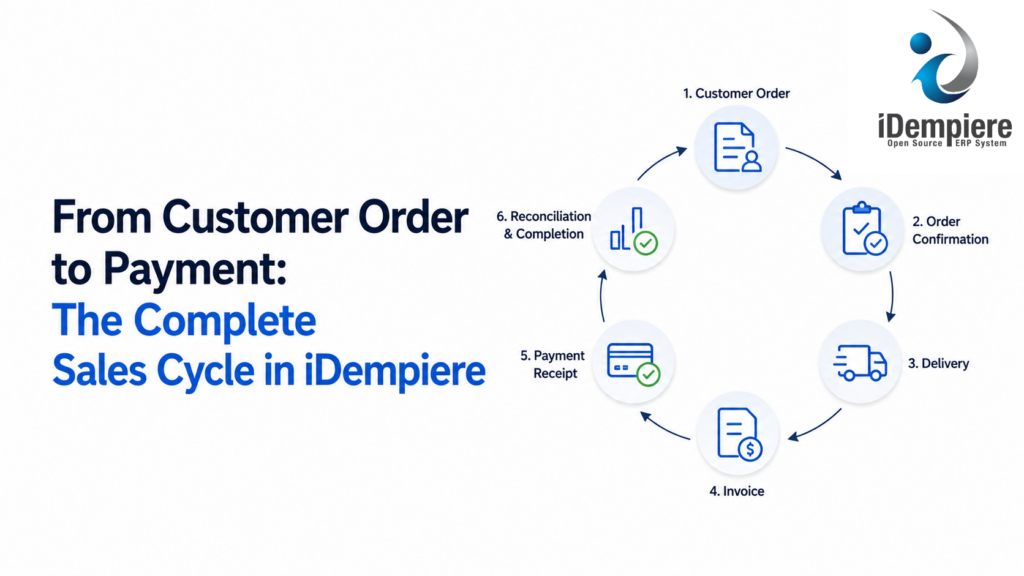
Every sale you make involves the same journey — order, delivery, invoice, payment — and if any handoff between those steps is manual or disconnected, you lose money to errors, delays, and lost visibility. iDempiere connects all four steps into a single continuous flow, so your team enters information once and the system carries it through automatically, giving you a real-time, accurate picture of every sale from the moment it’s placed to the moment you’re paid.
If you’re currently running an older ERP, a patched-together mix of spreadsheets and accounting software, or a system that’s starting to feel like it’s held together with tape, this is the part of “switching ERPs” that matters most to your bottom line. Let’s walk through it in plain terms.
Why This Matters to Your Business (Not Just Your IT Team)
Most ERP evaluations get bogged down in technical comparisons. But the real question every business owner or operations leader should ask is simpler:
“When my company makes a sale, how many times does someone have to re-type the same information — and how many chances does that create for a mistake?”
In a lot of legacy systems, the answer is: a lot. Sales creates the order in one tool. Warehouse staff check stock in another. Accounting re-enters the invoice in a third. Someone has to manually match the payment when it comes in. Every one of those handoffs is a place where:
- Numbers get typed wrong
- Orders get lost or forgotten
- Invoices go out late (or not at all)
- Nobody can tell you, at a glance, “where is this order right now?”
iDempiere was built around a different idea: one sale, one continuous record, from the first click to the final payment.
The Four Stages of the Sales Cycle
Here’s what actually happens inside iDempiere when a customer places an order — described the way you’d explain it to a new employee, not a programmer.
1. The Order Comes In
A salesperson (or a customer, if you sell online) creates a Sales Order. This single record captures who’s buying, what they want, how much, at what price, and any special terms — discounts, payment terms, shipping instructions.
Business value: This becomes the single source of truth for the entire sale. Nobody downstream has to guess or ask “what did the customer actually order?”
2. The System Checks What’s Really Available
The moment that order is confirmed, iDempiere automatically checks your inventory and reserves the stock needed to fulfill it. This prevents the classic problem of promising the same item to two different customers.
Business value: You stop overselling. You stop the awkward phone call where you have to tell a customer “actually, we’re out of that.”
3. Delivery Is Recorded and Triggers the Invoice
When the warehouse ships the goods (or the service is delivered), that action is logged in the system. Because the shipment is linked directly back to the original order, iDempiere can automatically generate the invoice — with the right items, quantities, and prices already filled in.
Business value: No one has to remember to invoice. No one has to manually copy numbers from the order into a separate invoicing tool. This alone eliminates a huge source of billing delays and billing errors, which directly affects how fast cash comes in the door.
4. Payment Comes In and Closes the Loop
When the customer pays — by check, bank transfer, or card — that payment is recorded and matched against the open invoice. The system automatically tracks what’s paid, what’s outstanding, and what’s overdue.
Business value: At any moment, your finance team (or you) can answer: “Who owes us money, how much, and for how long?” — without digging through spreadsheets.
Where These Projects Actually Go Wrong
Having guided companies through this exact kind of transition — including many coming off much older systems in the Compiere/Adempiere/iDempiere family, as well as other platforms — a few failure patterns show up again and again. These aren’t hypothetical; they are the reasons ERP switch-overs get expensive and painful when not planned properly.
Failure #1: Trying to copy your old broken process into the new system. Companies often ask us to make iDempiere “work exactly like our old system.” But if your old system’s workaround was a five-step manual re-entry process, replicating it just moves the same problem into new software. The right move is to redesign the process around the automation the new system already gives you.
Failure #2: Migrating messy historical data without cleaning it first. Old customer records, duplicate products, inconsistent pricing — if this data goes into the new system unfiltered, you inherit the mess instead of fixing it. A proper migration always includes a data cleanup phase before go-live.
Failure #3: Underestimating the training gap. The system is only as good as the people using it. Teams that skip structured training tend to fall back into old habits — manual spreadsheets on the side, informal workarounds — which quietly breaks the “one continuous record” benefit described above.
Failure #4: No clear owner for the transition. ERP switches that succeed have one clear internal decision-maker driving the project. Ones that stall usually have the responsibility spread across too many people with no single point of accountability.
None of these are technology problems. They’re planning problems — and they’re entirely avoidable with the right upfront assessment.
What This Means If You’re Considering a Switch
If your current ERP requires your team to touch a sale three or four separate times before it’s fully processed and paid, that’s not a training issue — that’s a system architecture issue. iDempiere’s sales cycle is designed specifically to close that gap, connecting order, delivery, billing, and payment into one accurate, traceable flow.
Ready to See What This Looks Like With Your Own Numbers?
If you’d like a straightforward, no-pressure conversation about what a move to iDempiere would actually look like for your business — including a review of your current sales process and where the biggest wins would come from — reach out to speak with one of our senior architects. We’ll walk through your specific situation, not a generic sales pitch.