Pentaho Kubernetes: Integration
Orchestrate Your Complete Pentaho Data Platform with Kubernetes Automation
Most organizations using Kubernetes have the orchestration infrastructure but struggle to automate their complete data platform. Pentaho’s six core components integrate seamlessly with Kubernetes services, persistent volumes, and auto-scaling features, transforming your existing Kubernetes infrastructure into an automated data platform without requiring infrastructure changes—empowering smarter orchestration without disruption.
Solution Architecture Overview
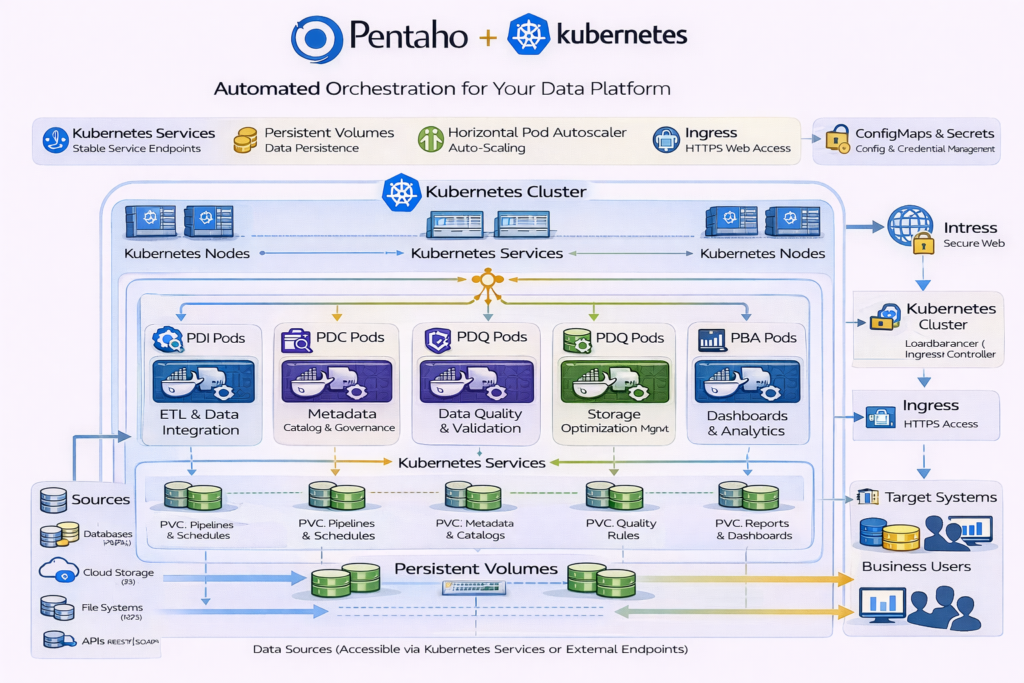
Pentaho Kubernetes Automated Orchestration for Your Data Platform:
Pentaho integrates with Kubernetes for automated orchestration—Kubernetes services enable Pentaho components to discover and communicate. Persistent volumes ensure Pentaho data and configurations survive pod restarts. Horizontal Pod Autoscaling automatically scales Pentaho based on workload. Ingress provides secure web access to Pentaho analytics. Orchestrate your complete Pentaho data platform with Kubernetes automation.
Learn how to integrate Pentaho with Docker or explore Pentaho AWS integration for cloud-native deployment options.
Most organizations using Kubernetes have the orchestration infrastructure but struggle to automate their complete data platform. Rising workload complexity, scaling challenges, and configuration management gaps are straining operations. Pentaho helps organizations strengthen their Kubernetes data capabilities through native integration that unifies automated deployment, scaling, persistence, and orchestration—empowering smarter orchestration without infrastructure disruption.
Deploy Pentaho on Kubernetes by using Kubernetes services for component discovery and communication, persistent volumes for data and configuration persistence, Horizontal Pod Autoscaling for automatic scaling, Ingress for secure web access, and ConfigMaps/Secrets for configuration management—all while leveraging your existing Kubernetes investment.
⚡ Zero Custom Code: Native Kubernetes Integration That Works Immediately
Pentaho components integrate directly with Kubernetes orchestration features—no custom integration code required. Data flows efficiently between Pentaho components using Kubernetes services, whether you’re deploying pods, scaling workloads, or persisting data.
Kubernetes Services → Enable Pentaho components to discover and communicate with each other automatically, provide stable network endpoints so components connect using the same service name even when pods restart or scale, distribute traffic across multiple Pentaho pods automatically ensuring optimal performance and high availability, and enable PDI to discover PDC services automatically cataloging metadata as it processes data.
Persistent Volumes → Enable Pentaho to persist data and configurations across pod restarts and updates, store PDI transformation definitions and job schedules so ETL pipelines survive pod restarts, store PDC metadata catalogs ensuring data discovery and lineage information persists, store PBA report definitions and dashboard configurations so analytics remain available after pod updates, enable data sharing between Pentaho components through shared volumes, and use persistent volume claims (PVCs) for dynamic storage provisioning allocated automatically when Pentaho pods need it.
Horizontal Pod Autoscaling (HPA) → Enables Pentaho to scale automatically based on workload, scales PDI pods automatically when ETL workloads increase creating more pods to handle increased data processing, scales PBA pods automatically when user traffic increases serving more reports and dashboards during peak usage, monitors CPU and memory usage automatically adding or removing Pentaho pods based on metrics, can scale based on custom metrics (queue depth, processing time, business metrics), and ensures Pentaho adapts to workload changes without manual intervention optimizing resource utilization and cost efficiency.
Ingress → Enables secure web access to Pentaho components, exposes PBA web interfaces through Ingress providing HTTPS access with TLS termination, routes traffic to appropriate PBA pods enabling load balancing and SSL/TLS encryption, enables path-based routing so different Pentaho components accessed through different URL paths, supports multiple authentication methods (OAuth, SAML, basic authentication) enabling integration with identity providers, and means users access PBA through a single URL while Kubernetes routes requests to appropriate pods.
ConfigMaps and Secrets → Enable Pentaho configuration management without hardcoding values, store PDI connection strings and PBA report settings in ConfigMaps so you can update configurations without rebuilding container images, store database passwords and API keys in Secrets encrypted at rest and accessible only to authorized pods, can be mounted as volumes in Pentaho pods so configurations and credentials available as files or environment variables, and mean Pentaho configurations and credentials managed as Kubernetes resources.
🚀 6 Ways This Accelerates Your Data Platform Deployment
- Faster Deployment: Native Kubernetes integration eliminates custom orchestration code—reduce timelines without infrastructure changes. No integration layers needed—Pentaho integrates natively.
- Automated Scaling: Horizontal Pod Autoscaling scales Pentaho automatically based on workload ensuring optimal resource utilization. HPA handles variable workloads without manual intervention.
- Persistent Operations: Persistent volumes ensure Pentaho data and configurations survive pod restarts and updates. PVCs provide dynamic storage provisioning automatically.
- Complete Orchestration: Kubernetes services enable automatic component discovery and communication. Load balancing distributes traffic across pods automatically.
- Seamless Management: ConfigMaps and Secrets enable configuration management without hardcoding values. Kubernetes manages all Pentaho configurations as resources.
- Secure Access: Ingress provides secure web access with TLS termination and authentication integration. Path-based routing enables flexible access patterns.
🔄 How It Works: 4 Stages from Deployment to Orchestration
Stage 1: Deployment → Pentaho components deploy as Kubernetes deployments using Kubernetes services for service discovery. Persistent volumes store transformation definitions, metadata catalogs, and report configurations. ConfigMaps and Secrets provide configuration and credential management.
Stage 2: Discovery & Communication → Kubernetes services enable Pentaho components to discover and communicate with each other automatically. PDI pods discover PDC services through Kubernetes service discovery automatically cataloging metadata. PBA pods discover PDI services enabling analytics to query processed data.
Stage 3: Scaling & Processing → Horizontal Pod Autoscaling scales Pentaho pods automatically based on workload (CPU, memory, custom metrics). PDI pods scale when ETL workloads increase. PBA pods scale when user traffic increases. Kubernetes load balancing distributes traffic across pods automatically.
Stage 4: Access & Management → Ingress provides secure web access to Pentaho components with TLS termination and authentication. PBA web interfaces exposed through Ingress with path-based routing. ConfigMaps and Secrets enable configuration updates without rebuilding container images.
All Pentaho components run as Kubernetes pods, using Kubernetes services, persistent volumes, HPA, Ingress, ConfigMaps, and Secrets. Infrastructure orchestrates automatically based on workload and configuration.
💼 Real-World Results: How Organizations Use Pentaho with Kubernetes
Cloud-Native Data Platform: Organizations building cloud-native data platforms use Kubernetes to orchestrate Pentaho components automatically, Kubernetes services enable component discovery and communication without manual configuration, persistent volumes ensure data and configurations persist across pod restarts, Horizontal Pod Autoscaling scales Pentaho automatically based on workload, and Ingress provides secure web access with TLS termination. This approach uses Kubernetes for orchestration, with Pentaho components handling data operations.
Multi-Environment Deployment: Organizations deploying across multiple environments use Kubernetes to deploy Pentaho consistently, ConfigMaps enable environment-specific configurations without rebuilding container images, Secrets provide secure credential management across environments, persistent volumes ensure data persistence across environments, and Kubernetes services enable consistent networking across environments. This approach uses Kubernetes for multi-environment orchestration, with Pentaho components handling data operations.
Auto-Scaling Analytics: Organizations needing auto-scaling analytics use Horizontal Pod Autoscaling to scale PBA pods automatically based on user traffic, Kubernetes services distribute traffic across PBA pods ensuring optimal performance, persistent volumes store report definitions and dashboard configurations, Ingress provides secure web access with load balancing, and ConfigMaps enable configuration updates without downtime. This approach uses Kubernetes for auto-scaling, with Pentaho components handling analytics operations.
Frequently Asked Questions
How does Pentaho integrate with Kubernetes?
Pentaho integrates with Kubernetes using Kubernetes services for component discovery and communication, persistent volumes for data and configuration persistence, Horizontal Pod Autoscaling for automatic scaling, Ingress for secure web access, and ConfigMaps/Secrets for configuration management. All Pentaho components run as Kubernetes pods with native integration.
What Kubernetes features does Pentaho support?
Pentaho supports Kubernetes services for service discovery, persistent volumes for data persistence, Horizontal Pod Autoscaling for automatic scaling based on workload, Ingress for secure web access with load balancing, ConfigMaps for configuration management, and Secrets for secure credential storage.
How to set up Pentaho on Kubernetes?
Deploy Pentaho on Kubernetes by creating Kubernetes services for each Pentaho component, configuring persistent volumes for data and configurations, setting up Horizontal Pod Autoscaling for automatic scaling, configuring Ingress for web access, and using ConfigMaps/Secrets for configuration management. All components run as Kubernetes pods.
Does Pentaho require custom Kubernetes configuration?
Pentaho components run as standard Kubernetes pods with standard configurations. Services, persistent volumes, autoscaling, and Ingress use standard Kubernetes resources. Custom configurations are only needed for specific deployment requirements, not for basic functionality.
What are the benefits of Pentaho on Kubernetes?
Key benefits include automated orchestration (services, autoscaling), data persistence (persistent volumes), automatic scaling (Horizontal Pod Autoscaling), secure access (Ingress with SSL), configuration management (ConfigMaps/Secrets), and high availability (pod replication and failover).
Can Pentaho scale automatically on Kubernetes?
Yes. Horizontal Pod Autoscaling automatically scales Pentaho pods based on CPU, memory, or custom metrics. Kubernetes services distribute traffic across scaled pods, ensuring optimal performance and resource utilization as workload changes.
How does Pentaho ensure data persistence on Kubernetes?
Pentaho uses Kubernetes persistent volumes to store data and configurations. Persistent volumes survive pod restarts, ensuring data and configurations are preserved. Volumes can be dynamically provisioned or use existing storage classes.
🎯 Ready to orchestrate your Pentaho data platform?
Pentaho integrates natively with your existing Kubernetes clusters—no infrastructure changes required. Use Kubernetes services for component discovery and communication, persistent volumes for data and configuration persistence, Horizontal Pod Autoscaling for automatic scaling, Ingress for secure web access, and ConfigMaps/Secrets for configuration management—all while leveraging your existing Kubernetes investment.
Contact TenthPlanet for expert Pentaho Kubernetes deployment services and implementation support.
Note:
This blueprint provides a comprehensive guide for implementing Pentaho with Kubernetes. Actual implementations may vary based on specific requirements, workload patterns, compliance needs, and budget constraints.
