Pentaho OKTA: Integration
Secure Your Complete Pentaho Data Platform with OKTA Single Sign-On
Most organizations using OKTA have identity management infrastructure but struggle to secure their complete data platform. Pentaho’s six core components integrate seamlessly with OKTA SSO, transforming your existing OKTA infrastructure into a unified secure data platform without requiring infrastructure changes—empowering smarter security without disruption.
Solution Architecture Overview
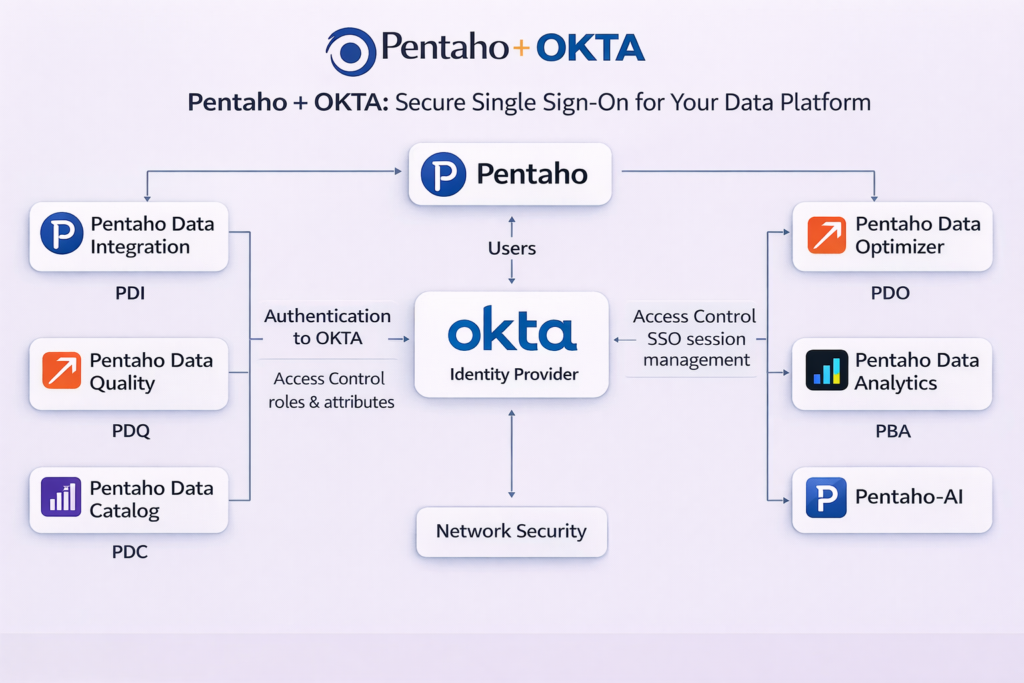
Pentaho OKTA Secure Single Sign-On for Your Data Platform:
Pentaho integrates seamlessly with OKTA for centralized identity management—PDI, PDC, PDQ, PDO, PBA, and Pentaho-AI all use OKTA SSO for secure authentication. Users authenticate once through OKTA and access all Pentaho components. PDC tracks data ownership based on OKTA identities. PDQ enforces quality permissions through OKTA groups. PBA delivers analytics with OKTA-based access control. Secure your entire data platform with OKTA identity management.
Learn how to integrate Pentaho with Gluu or explore Pentaho SSO configuration for additional authentication options.
For detailed OKTA documentation, refer to the official OKTA documentation and OKTA SSO configuration guides. Learn more about Pentaho security features capabilities.
Most organizations using OKTA for identity management have the infrastructure but struggle to secure their complete data platform. Rising security requirements, access control complexity, and governance gaps are straining operations. Pentaho helps organizations strengthen their OKTA data capabilities through native integration that unifies secure authentication, authorization, governance, and access control—empowering smarter security without infrastructure disruption.
Deploy Pentaho with OKTA by using OKTA SSO for secure authentication across all Pentaho components, OKTA user groups and attributes for role-based access control, OKTA-managed credentials for API authentication, and OKTA identity integration for data ownership and governance—all while leveraging your existing OKTA investment.
⚡ Zero Custom Code: Native OKTA Integration That Works Immediately
Pentaho components integrate directly with OKTA using SAML or OpenID Connect protocols—no custom integration code required. Authentication flows efficiently between Pentaho and OKTA, whether you’re authenticating users, enforcing access control, or managing identities.
Pentaho Data Integration (PDI) → Integrates with OKTA for secure authentication so only authorized users can access and run data pipelines, uses OKTA’s SAML or OpenID Connect authentication ensuring users authenticated through OKTA identity provider, enforces role-based access control based on OKTA user groups and attributes so different users have different permissions, can use OKTA for API authentication so when PDI connects to external systems it uses OKTA-managed credentials securely, and runs with OKTA SSO enabled giving centralized identity management for all ETL operations.
Pentaho Data Catalog (PDC) → Integrates with OKTA to manage user access to data catalogs and metadata, uses OKTA authentication to identify users then applies access control based on OKTA user groups and attributes so users only see data sources they’re authorized to access, business glossary and data lineage features work with OKTA user identities so you can track who discovered data and who owns data sources, governance features integrate with OKTA’s group management ensuring data stewardship aligns with organizational identity structure, and runs with OKTA SSO providing secure access to metadata and data catalogs.
Pentaho Data Quality (PDQ) → Integrates with OKTA to control who can run data quality checks and view quality results, uses OKTA authentication to identify users then enforces permissions based on OKTA groups ensuring only authorized users can profile data or run quality rules, quality dashboards and reports respect OKTA-based access control so users only see quality metrics for data they’re authorized to access, compliance features work with OKTA user attributes allowing you to track who validated data and who approved quality rules, and runs with OKTA SSO ensuring secure access to data quality operations.
Pentaho Data Optimizer (PDO) → Integrates with OKTA for secure access to storage optimization features, uses OKTA authentication to identify administrators who can configure storage policies and view cost optimization reports, enforces role-based access control based on OKTA user groups ensuring only authorized administrators can modify storage configurations, cost optimization reports and ROT detection results accessible based on OKTA permissions so users only see storage information they’re authorized to view, lifecycle management features work with OKTA groups allowing you to control who can approve data tiering or deletion policies, and runs with OKTA SSO providing secure access to storage management features.
Pentaho Business Analytics (PBA) → Integrates with OKTA for seamless single sign-on so users authenticate once through OKTA and access all PBA reports and dashboards without additional logins, uses OKTA’s SAML or OpenID Connect protocols providing smooth user experience while maintaining security, enforces access control based on OKTA user groups and attributes so users only see reports they’re authorized to access, self-service analytics features work with OKTA identities allowing you to track who created reports and who shared dashboards, JSON API export features can use OKTA-managed API credentials ensuring secure programmatic access, and runs with OKTA SSO providing centralized authentication for all business users.
Pentaho-AI → Works with OKTA to ensure AI-driven features respect user identity and permissions, PDC’s Pentaho-AI discovery features track which users discovered data sources based on OKTA authentication, PDQ’s ML anomaly detection results accessible based on OKTA permissions ensuring sensitive quality issues only visible to authorized users, PBA’s Pentaho-AI predictive insights respect OKTA-based access control so users only see AI-generated recommendations for data they’re authorized to access, PDI’s intelligent pipelines use OKTA authentication for secure execution ensuring automated operations performed by authenticated users, and runs within Pentaho components with OKTA SSO providing secure access to AI-powered features.
🚀 6 Ways This Accelerates Your Secure Data Platform Deployment
- Faster Deployment: Native OKTA integration eliminates custom authentication code—reduce timelines without infrastructure changes. No integration layers needed—Pentaho integrates natively.
- Centralized Identity: OKTA SSO enables users to authenticate once and access all Pentaho components seamlessly. OKTA manages user identities, groups, and permissions centrally.
- Complete Access Control: Role-based access control based on OKTA user groups and attributes ensures users only access what they’re authorized to see. OKTA integration enables fine-grained permissions.
- Complete Governance: OKTA user identities enable tracking who discovered data, who owns data sources, and who accessed specific data. OKTA groups align with organizational identity structure.
- Seamless Security: OKTA-managed API credentials ensure secure programmatic access to Pentaho components. OKTA authentication works across all Pentaho components consistently.
- Business-Aligned Security: Tight integration ensures access control addresses genuine business requirements. OKTA groups connect technical permissions to business roles.
🔄 How It Works: 4 Stages from Authentication to Secure Operations
Stage 1: Authentication → Users authenticate once through OKTA using SAML or OpenID Connect protocols. OKTA identity provider validates user credentials and provides authentication tokens. Pentaho components use OKTA authentication to identify users and enforce access control.
Stage 2: Authorization → Pentaho components apply access control based on OKTA user groups and attributes. PDI enforces role-based access control for data pipeline operations. PDC applies access control for data catalog and metadata access. PDQ enforces permissions for data quality operations.
Stage 3: Governance → OKTA user identities enable tracking who discovered data, who owns data sources, and who accessed specific data. PDC’s governance features integrate with OKTA’s group management. PDQ’s compliance features work with OKTA user attributes tracking who validated data.
Stage 4: Operations → OKTA-managed API credentials ensure secure programmatic access to Pentaho components. PBA’s JSON API export features use OKTA-managed credentials. PDI’s intelligent pipelines use OKTA authentication for secure execution. All Pentaho components run with OKTA SSO providing centralized authentication.
All Pentaho components integrate with OKTA using SAML or OpenID Connect protocols, so authentication flows efficiently without custom integration code. Security scales automatically based on OKTA identity management.
💼 Real-World Results: How Organizations Use Pentaho with OKTA
Enterprise Single Sign-On: Organizations using OKTA for enterprise identity management use OKTA SSO to enable users to authenticate once and access all Pentaho components seamlessly, OKTA user groups and attributes enable role-based access control across all Pentaho components, OKTA-managed API credentials ensure secure programmatic access, and OKTA identity integration enables tracking who accessed data and who owns data sources. This approach uses OKTA for centralized identity management, with Pentaho components handling data operations.
Multi-Component Security: Organizations securing multiple Pentaho components use OKTA SSO to provide consistent authentication across PDI, PDC, PDQ, PDO, PBA, and Pentaho-AI, OKTA groups enable consistent access control policies across all components, OKTA user attributes enable fine-grained permissions, and OKTA identity integration enables unified governance tracking. This approach uses OKTA for unified security, with Pentaho components handling data operations.
Compliance and Governance: Organizations needing compliance and governance use OKTA user identities to track who discovered data and who accessed specific data, OKTA groups align with organizational identity structure ensuring data stewardship aligns with business roles, OKTA user attributes enable compliance tracking (who validated data, who approved quality rules), and OKTA-managed credentials ensure secure access to sensitive data. This approach uses OKTA for compliance, with Pentaho components handling data operations.
Frequently Asked Questions
How does Pentaho integrate with OKTA?
Pentaho integrates seamlessly with OKTA for centralized identity management using SAML 2.0 or OAuth 2.0. All Pentaho components (PDI, PDC, PDQ, PDO, PBA, Pentaho-AI) use OKTA SSO for secure authentication. Users authenticate once through OKTA and access all Pentaho components without additional logins.
What OKTA features does Pentaho support?
Pentaho supports OKTA SSO for single sign-on authentication, OKTA user groups for role-based access control, OKTA user attributes for fine-grained permissions, OKTA-managed credentials for API authentication, and OKTA identity integration for data ownership and governance tracking.
How to set up Pentaho OKTA integration?
Deploy Pentaho with OKTA by configuring OKTA as identity provider with SAML 2.0 or OAuth 2.0, setting up OKTA user groups for role-based access control, configuring OKTA user attributes for permissions, integrating OKTA identities with Pentaho components, and setting up OKTA-managed credentials for API access.
Does Pentaho require custom code for OKTA integration?
No. Pentaho components integrate with OKTA using standard SAML 2.0 or OAuth 2.0 protocols—no custom code required. Configuration is done through Pentaho security settings and OKTA application configuration, using standard identity provider protocols.
What are the benefits of Pentaho OKTA integration?
Key benefits include centralized identity management (single sign-on), consistent access control (OKTA groups), fine-grained permissions (OKTA attributes), unified governance (OKTA identity tracking), secure API access (OKTA-managed credentials), and compliance tracking (OKTA audit logs).
Can OKTA provide role-based access control for Pentaho?
Yes. OKTA user groups map to Pentaho roles, enabling role-based access control across all Pentaho components. OKTA user attributes provide fine-grained permissions, and OKTA identity integration enables unified governance tracking based on OKTA identities.
How does OKTA ensure compliance and governance?
OKTA user identities track who discovered data and who accessed specific data. OKTA groups align with organizational structure ensuring data stewardship aligns with business roles. OKTA user attributes enable compliance tracking (who validated data, who approved quality rules). OKTA-managed credentials ensure secure access to sensitive data.
🎯 Ready to secure your Pentaho data platform?
Pentaho integrates natively with your existing OKTA identity provider—no infrastructure changes required. Use OKTA SSO for secure authentication across all Pentaho components, OKTA user groups and attributes for role-based access control, OKTA-managed credentials for API authentication, and OKTA identity integration for data ownership and governance—all while leveraging your existing OKTA investment.
Contact TenthPlanet for expert Pentaho OKTA integration services and implementation support.
Note:
This blueprint provides a comprehensive guide for implementing Pentaho with OKTA. Actual implementations may vary based on specific requirements, security policies, compliance needs, and budget constraints. Refer to OKTA documentation and Pentaho documentation for the most current integration details.
