Pentaho Azure: Integration

Turn Your Azure Infrastructure Into a Complete Data Platform
Most organizations using Microsoft Azure have the infrastructure but struggle to turn it into a complete data platform. Pentaho’s six core components integrate natively with Azure services, transforming your existing Azure infrastructure into a unified data platform without requiring infrastructure changes—empowering smarter data operations without disruption.
Solution Architecture Overview
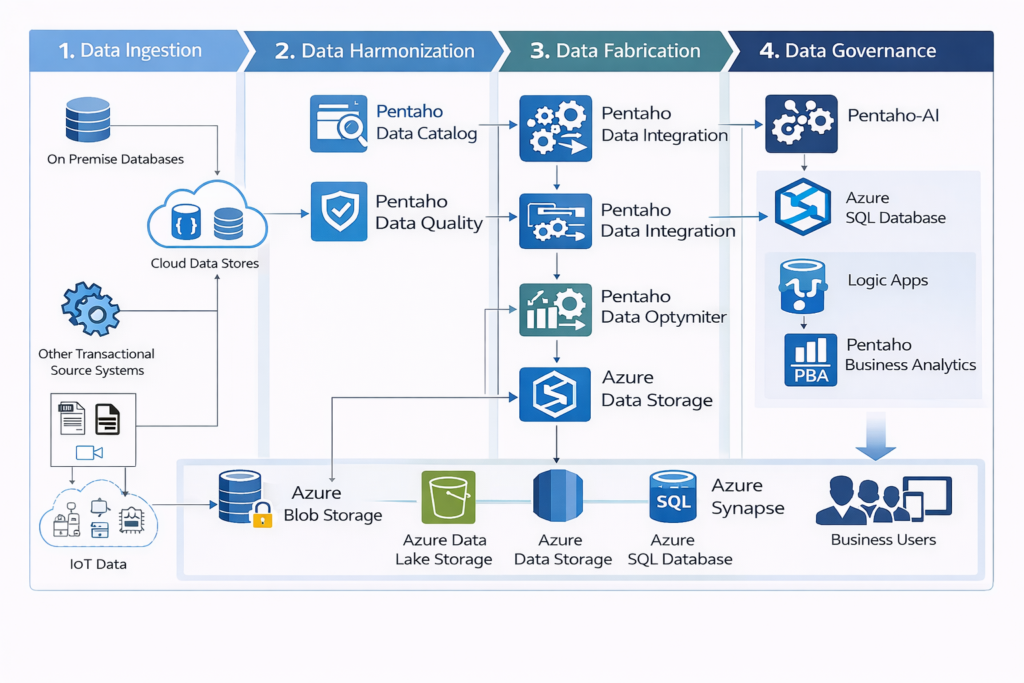
Pentaho Azure Turn Your Cloud Infrastructure Into a Complete Data Platform
Pentaho integrates natively with Azure services—PDI connects directly to Blob Storage, Synapse Analytics, Azure SQL Database, and Event Hubs for seamless data integration. PDC auto-discovers and catalogs all Azure data sources. PDQ validates data quality before it reaches Azure storage. PDO optimizes Azure storage costs automatically. PBA creates reports and dashboards from Azure data. Turn your Azure infrastructure into a complete data platform.
Learn how to integrate Pentaho with AWS or explore Pentaho GCP integration for similar cloud data platform solutions.
Most organizations using Microsoft Azure have the infrastructure but struggle to turn it into a complete data platform. Rising data volumes, fragmented services, and governance challenges are straining data operations. Pentaho helps organizations strengthen their Azure data capabilities through native integration that unifies data integration, quality, governance, optimization, and analytics—empowering smarter data operations without infrastructure disruption.
Deploy Pentaho on Azure by connecting PDI to your Blob Storage containers and Synapse Analytics workspaces, using PDC to discover and catalog your Azure data, applying PDQ to validate data quality, optimizing storage costs with PDO, and delivering analytics through PBA—all while leveraging your existing Azure investment.
⚡ Zero Custom Code: Native Azure Integration That Works Immediately
Pentaho components connect directly to Azure services using native connectors—no custom integration code required. Data flows efficiently between Pentaho and Azure services, whether you’re processing batch data in Blob Storage, streaming data through Event Hubs, or analyzing data in Synapse Analytics.
Pentaho Data Integration (PDI) → Reads/writes to Blob Storage containers directly, processes Event Hubs streams in real-time, loads data into Synapse Analytics using ETL/ELT patterns, connects to Azure SQL Database as sources or targets, provides unified pipeline control across your Azure environment, and runs on Azure Virtual Machines or Container Instances with auto-scaling.
Pentaho Data Catalog (PDC) → AI-driven discovery scans and catalogs all Azure data sources (Blob Storage, Azure SQL Database, Synapse Analytics) without manual configuration, tracks complete data lineage using Open Lineage standard, ML-driven business glossary connects technical structures to business terms, and runs on Azure Virtual Machines or Container Instances for continuous governance.
Pentaho Data Quality (PDQ) → One-click instant profiling of Blob Storage data identifies structure, completeness, accuracy, and patterns automatically, built-in ML models detect anomalies without requiring data scientists, applies 250+ predefined quality rules for GDPR/SOX/HIPAA compliance, continuously monitors data quality through PDI pipelines preventing bad data from reaching storage, and runs on Azure Virtual Machines for pre-entry validation.
Pentaho Data Optimizer (PDO) → Moves data between Blob Storage access tiers based on usage patterns (hot/cool/archive), identifies ROT data reducing storage costs by 30-50%, manages data lifecycle across Blob Storage and Azure SQL Database for optimal cost and performance, and runs on Azure Virtual Machines for automated cost reduction.
Pentaho Business Analytics (PBA) → Connects to Synapse Analytics/Azure SQL Database/Blob Storage for self-service reports and dashboards, no SQL required—handles connections and query optimization, creates real-time dashboards from Event Hubs streams, intelligent query caching reduces report times from minutes to seconds, provides Gauge/Radar charts for executive dashboards, delivers data via JSON export URLs, and runs on Azure Virtual Machines or Container Instances with auto-scaling.
Pentaho-AI → PDC’s Pentaho-AI discovers and classifies Azure Blob Storage data sources identifying dark data, PDQ’s ML models detect anomalies without external ML services, PBA’s Pentaho-AI provides predictive insights and recommendations, PDI’s intelligent pipelines optimize data processing automatically, and all intelligence runs within Pentaho components on Azure Virtual Machines—no separate AI services needed.
🚀 6 Ways This Accelerates Your Data Platform Deployment
- Faster Deployment: Native Azure integration eliminates custom code—reduce timelines without infrastructure changes. No integration layers needed—Pentaho connects natively.
- Better Data Quality: Clean, validated data translates to accurate analytics. PDQ’s 250+ quality rules and ML-powered anomaly detection ensure data is trustworthy before it reaches analytics.
- Lower Storage Costs: Automated optimization reduces Azure storage costs by 30-50% through intelligent lifecycle management. PDO continuously monitors and moves data to appropriate tiers.
- Complete Governance: Full data lineage and governance frameworks ensure Azure data remains auditable and compliant. PDC tracks every transformation, PDQ ensures GDPR/SOX/HIPAA compliance.
- Seamless Scaling: Pentaho scales automatically on Azure infrastructure as data volumes grow. Auto-scaling handles variable workloads without over-provisioning.
- Business-Aligned Analytics: Tight integration ensures Azure data addresses genuine business challenges. PBA’s business glossary connects technical structures to business terms.
🔄 How It Works: 4 Stages from Data Ingestion to Business Insights
Stage 1: Ingestion → PDI loads data from any source into Blob Storage landing zones or processes Event Hubs streams in real-time. Azure Logic Apps schedules PDI pipelines automatically, triggering jobs based on Blob Storage events or custom schedules. PDI handles connection management, error handling, and retry logic automatically.
Stage 2: Discovery & Quality → PDC automatically discovers and catalogs all Azure data using AI-driven discovery. PDQ performs one-click instant profiling and applies 250+ predefined quality rules automatically. PDQ’s ML models detect anomalies, ensuring you know what data you have and that it’s trustworthy.
Stage 3: Transformation → PDI extracts data from Blob Storage or Event Hubs, transforming it according to business rules (cleansing, format conversion, aggregation, enrichment). PDQ validates data quality continuously as it flows through PDI pipelines. Transformed data loads into target systems (Blob Storage data lake, Azure SQL Database, or Synapse Analytics) using bulk loading for efficiency.
Stage 4: Governance & Analytics → PDC tracks complete data lineage from sources through transformations to targets. PDC’s business glossary connects technical structures to business terms. PDO monitors and optimizes storage costs automatically. PBA creates reports and dashboards from Azure data sources with intelligent query caching, delivering data via JSON export URLs.
All Pentaho components run on Azure Virtual Machines or Container Instances, connecting natively to Blob Storage, Azure SQL Database, Synapse Analytics, Event Hubs, and Logic Apps. Infrastructure scales automatically based on workload.
💼 Real-World Results: How Organizations Use Pentaho on Azure
Data Lake on Azure: Organizations building data lakes on Azure Blob Storage use PDI to load data from various sources, PDC to discover and catalog Blob Storage data with AI-driven discovery, PDQ to ensure data quality with one-click profiling and 250+ rules, PBA to create reports and dashboards making the lake accessible to business users, and PDO to optimize Blob Storage costs automatically. This approach uses Azure Blob Storage and Azure RBAC, with Pentaho components handling all data operations.
Real-Time IoT Analytics: When IoT devices generate continuous streams, IoT devices stream data to Azure Event Hubs, PDI processes streams in real-time transforming and routing data, PDQ validates streaming data quality continuously, and PBA creates real-time dashboards giving immediate visibility into IoT operations. This approach uses Azure Event Hubs and Blob Storage, with Pentaho components handling processing, quality, and analytics.
Cloud Data Warehouse: Organizations using Azure Synapse Analytics use PDI to load data using ELT patterns, PBA connects to Synapse Analytics for reporting and dashboards serving business users directly, PDC tracks complete lineage providing governance and compliance, and PDQ ensures data quality before loading preventing expensive issues. This approach uses Azure Synapse Analytics, Blob Storage, and Azure SQL Database, with Pentaho components handling integration, quality, governance, and analytics.
Frequently Asked Questions
How does Pentaho integrate with Azure?
Pentaho integrates natively with Azure services including Blob Storage, Synapse Analytics, Azure SQL Database, and Event Hubs through direct connectors, requiring no custom code. PDI connects to Blob Storage containers and Synapse Analytics workspaces, PDC catalogs Azure data sources, PDQ validates data quality, PDO optimizes storage costs, and PBA delivers analytics—all running on Azure infrastructure.
What Azure services does Pentaho support?
Pentaho supports native integration with Azure Blob Storage (object storage), Azure Synapse Analytics (data warehouse), Azure SQL Database (managed databases), Azure Event Hubs (streaming data), and Azure compute services. All Pentaho components can run on Azure infrastructure.
How to set up Pentaho Azure integration?
Deploy Pentaho on Azure by connecting PDI to your Blob Storage containers and Synapse Analytics workspaces, using PDC to discover and catalog your Azure data, applying PDQ to validate data quality, optimizing storage costs with PDO, and delivering analytics through PBA. All components run on Azure infrastructure with auto-scaling capabilities.
Does Pentaho require custom code for Azure integration?
No. Pentaho components connect directly to Azure services using native connectors—no custom integration code required. Data flows efficiently between Pentaho and Azure services whether you’re processing batch data in Blob Storage, streaming data through Event Hubs, or analyzing data in Synapse Analytics.
What are the benefits of Pentaho Azure integration?
Key benefits include faster deployment (no custom code), better data quality (250+ quality rules), lower storage costs (30-50% reduction), complete governance (full data lineage), seamless scaling (auto-scaling on Azure), and business-aligned analytics (self-service reporting).
Can Pentaho reduce Azure storage costs?
Yes. Pentaho Data Optimizer (PDO) automatically moves data between Azure storage tiers based on usage patterns, identifies ROT (Redundant, Obsolete, Trivial) data, and manages data lifecycle across Blob Storage and Azure SQL Database for optimal cost and performance, reducing Azure storage costs by 30-50%.
How does Pentaho ensure data quality on Azure?
Pentaho Data Quality (PDQ) provides one-click instant profiling of Blob Storage data, built-in ML models for anomaly detection, and applies 250+ predefined quality rules for GDPR/SOX/HIPAA compliance. PDQ continuously monitors data quality through PDI pipelines, preventing bad data from reaching Azure storage.
🎯 Ready to transform your Azure infrastructure?
Pentaho integrates natively with your existing Azure services—no infrastructure changes required. Connect PDI to your Blob Storage containers and Synapse Analytics workspaces, use PDC to discover and catalog your Azure data, apply PDQ to validate data quality, optimize storage costs with PDO, and deliver analytics through PBA—all while leveraging your existing Azure investment.
Contact TenthPlanet for expert Pentaho Azure integration services and implementation support.
Note:
This blueprint provides a comprehensive guide for implementing Pentaho with Azure. Actual implementations may vary based on specific requirements, data volumes, compliance needs, and budget constraints.
Related Resources:
