Reverse Osmosis Membrane Fouling : Common Causes and Solutions
Transform Membrane Fouling Management From Reactive to Proactive With Predictive Analytics
When using membrane-based water treatment systems, membrane fouling can create significant issues for water operators. Reverse osmosis (RO), microfiltration (MF), nanofiltration (NF), and ultrafiltration (UF) are all membrane-based water treatment technologies prone to fouling. Membrane fouling decreases production, increases energy consumption, and can lead to costly equipment replacements.
Solution Architecture Overview
Learn about membrane fouling prediction or explore Pentaho data science solutions for comprehensive water treatment analytics.
Membrane fouling occurs when contaminants are deposited on the surface of a filtration membrane, restricting liquid flow through the membrane’s pores. Multiple factors can contribute to fouling, including excess biological, colloidal, and/or organic particles in source water; inappropriate membrane material choice; and unsuitable process conditions such as flow rate, temperature, and pressure.
- Cost reduction: Reduce operational costs and prevent costly equipment replacements
- Performance monitoring: Monitor membrane performance in real-time
- Predictive analytics: Predict fouling before it occurs using AI/ML models
- Data integration: Integrate data from multiple sources for comprehensive analysis
How Pentaho 10.2 helps: The unified data platform enables water treatment facilities to monitor, analyze, and predict membrane fouling through integrated data collection, quality validation, and predictive analytics. AI/ML-powered anomaly detection, real-time monitoring, and data science integrations with R, Python, and Spark transform membrane fouling management from reactive to proactive.
Common Causes for Membrane Fouling
- pH Extremes
- Oxidation
- Suspended Solids
- Scaling
- Organic
- Biological
- Temperature
Avoiding Membrane Fouling
Membrane fouling is sometimes reversible—but not always. That’s why it’s best to implement preventative measures to avoid or minimize membrane fouling in the first place. Below, are some common preventative measures to avoid membrane fouling.
Scheduled Cleaning
A systematic cleaning regimen can help to prevent foulants from building up on the membrane. Cleaning cycles should be scheduled monthly or at other regular intervals to provide the greatest benefit. Maintenance strategies can vary depending upon the membrane filtration system design and the types of contaminants involved, and can employ one or more cleaning methods, such as:
- Mechanical Cleaning involves the use of physical force to loosen contaminants from the membrane and flush them out of the system. Typical approaches include vibration, as well as backward or forward flushing, where water or a cleaning solution is run through the unit at a faster speed or higher pressure than in a normal service cycle, resulting in turbulence that removes foulants from the membrane.
- Chemical Cleaning involves the application of detergents, caustics, acids, antiscalants, or dispersants to loosen and remove foulants from the membrane surface. Cleaning chemicals are selected based on the type of contaminants present, with consideration also given to the membrane material to ensure that the chemicals used do not damage it.
System Design
Preventing membrane fouling is best accomplished by good planning and design. There are many variables that play a role in proper system function for a membrane filtration system, each of which should be considered when replacing a membrane or installing a new system. These include:
- Membrane material: Filtration membranes may be fabricated from a wide variety of synthetic polymers, ceramic, and metallic materials. Properties of the membrane material, such as its surface ionic charge, hydrophobicity, and pH tolerance range, determine whether the membrane will be resistant to certain types of fouling, and how well it will withstand process conditions and the necessary maintenance regimen.
- Membrane pore size: Pore size is the key factor to ensuring efficient removal of targeted contaminants by a membrane filtration unit. Selection of the proper membrane pore size can help to avoid fouling by optimizing permeate flux in light of other factors, such as feed water quality, temperature, and salt concentration.
- Operating conditions: Membrane fouling can be exacerbated by certain ranges of temperature, pH, transmembrane pressure, and flow rate. A well-designed system will balance these variables to ensure that foulants do not collect on the membrane surface.
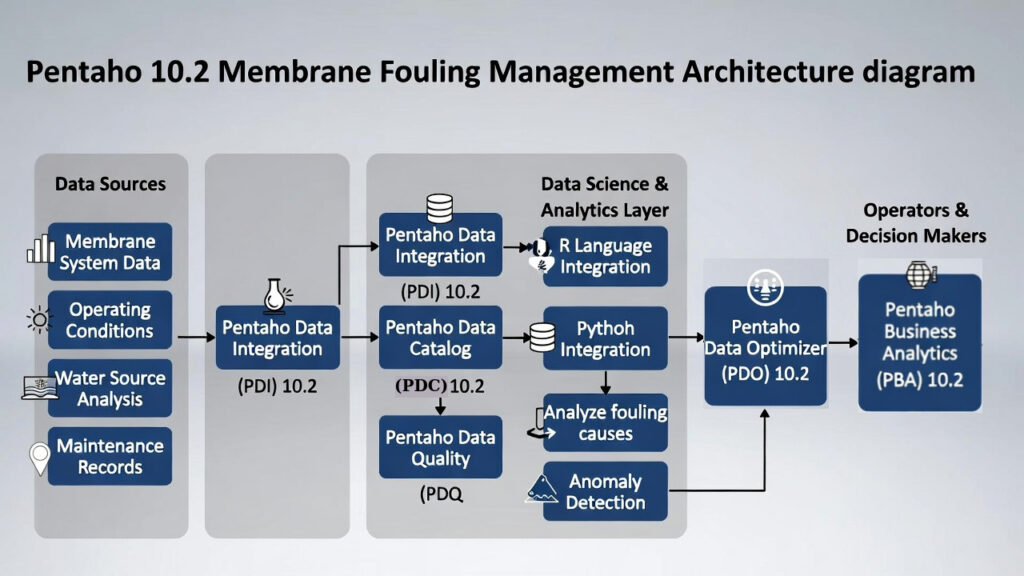
Pentaho 10.2 Solution Architecture for Membrane Fouling Management
How Pentaho 10.2 Addresses Membrane Fouling Challenges
The unified platform provides comprehensive data management and analytics capabilities for water treatment facilities managing membrane fouling. Here’s how each component helps:
Pentaho Data Integration (PDI) 10.2 collects data on membrane system variables – flow rate, temperature, pressure, pH – that contribute to fouling. It processes data on membrane material characteristics, pore size, and operating conditions. Java 17 gives you 2-3x faster data processing. Docker containers mean scalable deployment across treatment facilities.
Pentaho Data Catalog (PDC) 10.2 uses AI-driven discovery to automatically find and catalog all data sources related to membrane operations. Data lineage tracking goes from data sources through processing to analytics. ML-driven business glossary connects technical terms to operational language operators understand. Automated policy creation handles data retention and compliance automatically.
Pentaho Data Quality (PDQ) 10.2 offers one-click instant profiling of membrane operation data to identify patterns and anomalies. 250+ predefined quality rules validate data – range checks, consistency, all that. AI/ML-powered anomaly detection finds unusual patterns that may indicate fouling. Continuous monitoring alerts operators immediately when data deviates. Automated issue resolution flags data quality problems before they affect analysis.
Pentaho Data Optimizer (PDO) 10.2 uses intelligent ROT detection to identify redundant or obsolete historical data. Rules-based tiering moves historical data to cost-effective storage. Storage costs typically drop by 30-50% while maintaining access to historical trends.
Pentaho Business Analytics (PBA) 10.2 creates real-time dashboards showing membrane performance metrics. Intelligent query caching provides instant insights – reports that took 5 minutes now take 30 seconds. Gauge charts display key performance indicators with thresholds. Self-service analytics lets operators explore data without IT assistance. JSON export via URLs enables integration with other systems.
Key Benefits of Pentaho 10.2 for Membrane Fouling Management
- Data Collection: Collects data on membrane system variables (flow rate, temperature, pressure, pH) and operating conditions
- Fouling Cause Analysis: AI/ML-powered analysis identifies fouling causes (pH extremes, oxidation, suspended solids, scaling, organic, biological, temperature)
- Data Quality Assurance: 250+ quality rules ensure data is accurate and reliable for decision-making
- Automated Anomaly Detection: ML models automatically identify unusual patterns that may indicate fouling
- Integrated Analytics: R and Python integration enables advanced statistical analysis
- Self-Service Analytics: Operators can explore data and create reports without IT assistance
- Cost Optimization: Intelligent data tiering reduces storage costs by 30-50% while maintaining access to historical data
- Complete Visibility: Open Lineage tracking provides complete audit trail from data sources to analytics
Conclusion
Membrane fouling and scaling can be minimized by proper design and operating conditions. Important variables that control the membrane fouling must be considered in designing and operating the reverse osmosis system.
Pentaho 10.2’s unified platform enables organizations to make faster, more confident decisions about membrane maintenance, cleaning schedules, and system design optimization through trusted data insights.
Frequently Asked Questions
What causes reverse osmosis membrane fouling?
Reverse osmosis membrane fouling is caused by multiple factors including excess biological, colloidal, and organic particles in source water; inappropriate membrane material choice; unsuitable process conditions (flow rate, temperature, pressure); pH extremes; oxidation; suspended solids; scaling; and biological growth.
How does Pentaho help manage membrane fouling?
Pentaho 10.2 helps manage membrane fouling through data collection on membrane system variables, AI/ML-powered fouling cause analysis, data quality assurance (250+ quality rules), automated anomaly detection, integrated analytics (R and Python), self-service analytics for operators, and cost optimization through intelligent data tiering.
What are the common types of membrane fouling?
Common types of membrane fouling include biological fouling (microorganisms), colloidal fouling (fine particles), organic fouling (organic matter), scaling (mineral deposits), and combination fouling (multiple types occurring simultaneously). Each type requires different prevention and treatment strategies.
How does Pentaho identify fouling causes?
Pentaho identifies fouling causes through AI/ML-powered analysis of membrane system variables (flow rate, temperature, pressure, pH), operating conditions, water quality parameters, and historical fouling data. ML models automatically identify patterns and correlations indicating specific fouling causes.
Can Pentaho prevent membrane fouling?
Pentaho enables proactive fouling management through predictive analytics identifying when fouling is likely to occur, analysis of fouling causes enabling preventive measures, optimization of operating conditions, and data-driven decision-making for membrane maintenance and system design.
How does Pentaho optimize membrane costs?
Pentaho optimizes membrane costs through intelligent data tiering reducing storage costs by 30-50%, predictive analytics enabling planned maintenance and optimal membrane replacement timing, and cost analysis helping organizations make informed decisions about membrane purchases and maintenance schedules.
What data does Pentaho collect for fouling analysis?
Pentaho collects data on membrane system variables (flow rate, temperature, pressure, pH), operating conditions, water quality parameters, membrane material characteristics, historical fouling incidents, cleaning schedules, and maintenance records to build comprehensive fouling analysis and prediction models.
🎯 Ready to transform membrane fouling management?
Pentaho 10.2 transforms membrane fouling management from reactive to proactive with predictive analytics. With AI/ML-powered cause analysis, integrated analytics, and self-service capabilities, Pentaho enables water treatment facilities to prevent fouling and optimize operations.
Contact TenthPlanet for expert Pentaho data science and water treatment analytics implementation services.
Note: This guide provides a comprehensive overview of reverse osmosis membrane fouling causes and solutions using Pentaho 10.2. Actual implementations may vary based on specific membrane systems, water sources, and operational requirements.
Related Resources:
