Membrane Fouling Prediction : AI-Powered Analytics

Predict RO Membrane Fouling Before It Affects Plant Performance and Operational Costs
Since the introduction of the membrane industry in the 1970s, membrane fouling has been an inevitable phenomenon in membrane operations that severely affects plant performance and costs. Predicting fouling in RO systems enables diagnostic and preventive measures to rapidly limit fouling effects. Pentaho 10.2’s unified data platform with AI/ML capabilities, real-time data processing, and advanced analytics integrations with R, Python, and Spark enables water treatment facilities to build and deploy predictive models for membrane fouling.
Learn about reverse osmosis membrane fouling causes or explore Pentaho data science capabilities for comprehensive analytics solutions.
Key benefits:
- Predictive maintenance: Predict fouling before it occurs, enabling preventive measures
- Cost reduction: Reduce operational costs by minimizing fouling effects
- Performance optimization: Maintain optimal membrane performance
- Automated monitoring: Continuous monitoring with AI/ML-powered anomaly detection
- Data-driven decisions: Make informed decisions based on predictive insights
The tactics developed to predict membrane fouling can take several forms, including:
- Plant Evaluation
- Usage of Fouling Indices
- Usage of Predictive Models
Pentaho 10.2 Solution Architecture for Predictive Fouling Management
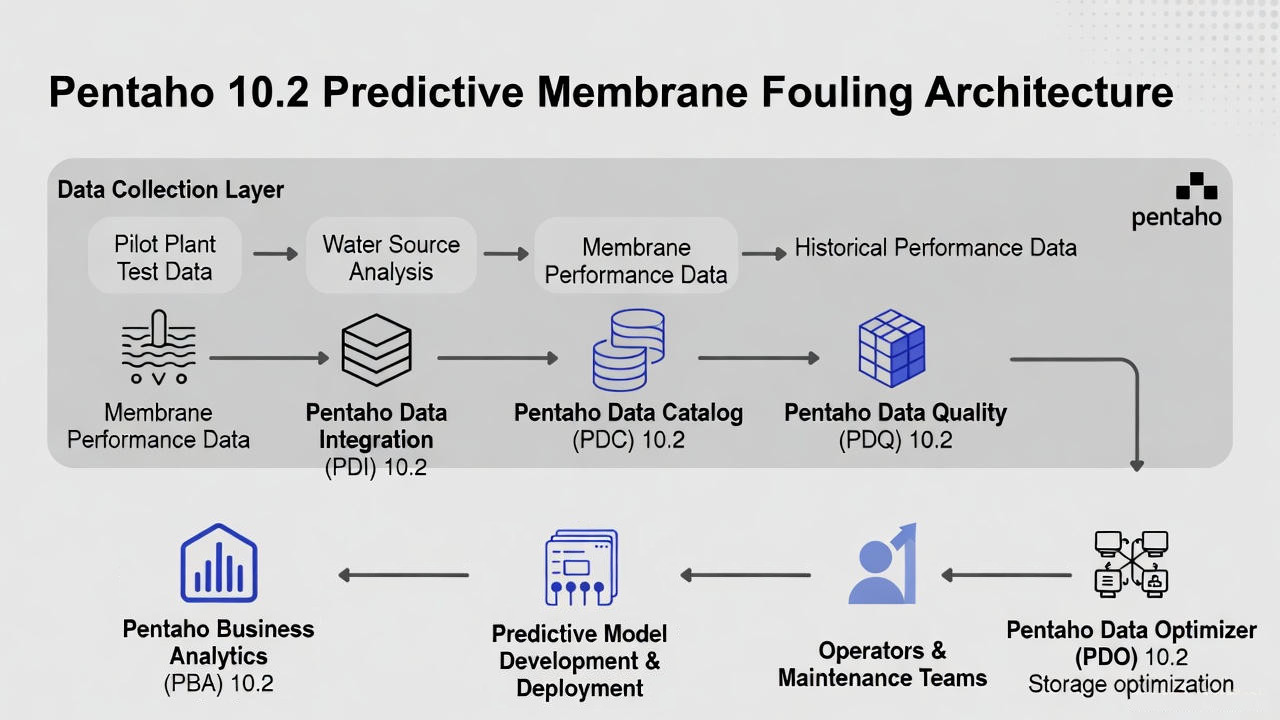
Architecture Overview
Pentaho 10.2’s unified platform enables end-to-end predictive fouling management from data collection through model deployment to actionable insights.
Solution Architecture Blueprint
Plant Evaluation
Plant studies involve the design of an optimal system based on the characteristics of the feed. Information obtained from the analysis of the proposed water source is used to develop a pre-treatment scheme for the feed water, evaluate the compatibility of one or more types of membranes with the feed water, as well as determine the optimal operating conditions.
Pilot plant tests are run for long hours (around several thousand hours) to gauge the performance of the membrane system. Although this method generally provides reasonably good predictability of membrane fouling, it is extremely costly and time-consuming.
Usage of Fouling Indices
Membrane fouling indices are predictive quantifiers that indicate how susceptible membranes are to fouling. The traditional and most widely applied fouling indices in RO systems are the silt density index (SDI) and the modified fouling index (MFI); however, these indices have several limitations, such as inadequate fouling prediction with small foulant agents, and neglecting cake-sustained osmotic pressure effects, as many of these fouling indices were developed before the recognition of such effects. Therefore, current research efforts have been devoted to improving the reliability and accuracy of these indices in predicting fouling-propensity. The following sections present the most commonly used fouling indices.
Usage of Predictive Models
Another approach for fouling prediction in membrane systems involves using mathematical prediction models. These mathematical models are valuable because they facilitate the optimization of fouling removal and prevention methods, and also help establish interactions and relationships between different filtration variables. Most equations aim at relating the time-dependent decline of the;
- Permeability
- Salt Rejection and
- Normalized Permeate Flow
These variables are used to determine the condition of the membrane in water treatment plants, the decline in the values tend to depict the possibility of decline in RO Membrane performance.
Key Benefits of Pentaho 10.2 for Predictive Fouling Management
- Integrated Data Science: R and Python integrations enable building mathematical prediction models and calculating fouling indices (SDI, MFI) without separate tools
- Faster Analysis: Java 17 provides 2-3x faster data processing, reducing time to analyze thousands of hours of pilot plant test data
- Data Quality Assurance: 250+ quality rules and AI/ML anomaly detection ensure model inputs are accurate
- Automated Monitoring: Continuous monitoring of model inputs and outputs with immediate alerts
- Self-Service Analytics: Operators can explore predictions and create reports without IT assistance
- Complete Lineage: Open Lineage tracking provides complete audit trail from data sources to predictions
- Predictive Models: Build models that relate time-dependent decline of permeability, salt rejection, and normalized permeate flow
- Business Benefits: Enable planned maintenance and membrane cost optimization (buy when actually needed)
Business Benefits of RO Fouling Prediction
- Membrane Cost Benefit – Buy when you actually need it. Predictive models enable proactive maintenance scheduling, reducing unexpected membrane replacements and optimizing inventory costs.
- Planned Maintenance – Predictive models identify when fouling is likely to occur, enabling scheduled maintenance during planned downtime rather than emergency repairs.
Conclusion
RO membrane processes are attractive technologies that have been widely used in desalination. A major challenge to this technology is membrane fouling. Membrane fouling depends on several factors including, the type of membrane material and membrane surface characteristics. This blog presented an overview of the different kinds of membrane fouling, the factors influencing fouling-propensity, tactics for the prediction of membrane fouling aimed at controlling and managing fouling occurrences.
Pentaho 10.2 transforms fouling prediction from a manual, time-consuming process to an automated capability. With integrated data science tools (R, Python), AI/ML-powered anomaly detection, continuous monitoring, and self-service analytics, Pentaho 10.2 enables water treatment facilities to:
- Build mathematical prediction models that relate time-dependent decline of membrane variables
- Calculate and analyze fouling indices (SDI, MFI) more efficiently
- Process thousands of hours of pilot plant test data faster
- Monitor membrane condition indicators continuously
- Take proactive action based on predictions for planned maintenance
- Optimize membrane costs by buying when actually needed
Pentaho 10.2’s unified platform enables organizations to make faster, more confident decisions about membrane maintenance and optimization through predictive analytics based on trusted data.
Frequently Asked Questions
How does Pentaho predict membrane fouling?
Pentaho 10.2 enables membrane fouling prediction through integrated data science tools (R, Python), AI/ML-powered anomaly detection, continuous monitoring of membrane condition indicators, mathematical prediction models relating time-dependent decline of membrane variables, and analysis of fouling indices (SDI, MFI).
What are the benefits of predictive fouling analytics?
Key benefits include predictive maintenance (predict fouling before it occurs), cost optimization (buy membranes when actually needed), planned maintenance (schedule maintenance during planned downtime), reduced downtime (prevent emergency repairs), and improved plant performance (maintain optimal membrane operation).
How does Pentaho process membrane data for prediction?
Pentaho processes membrane data through integrated R and Python tools for advanced statistical analysis, AI/ML-powered anomaly detection for unusual patterns, continuous monitoring of membrane variables (flow rate, temperature, pressure, pH), calculation of fouling indices, and processing of thousands of hours of pilot plant test data.
What data sources does Pentaho integrate for fouling prediction?
Pentaho integrates data from membrane system variables (flow rate, temperature, pressure, pH), operating conditions, pilot plant test data, historical fouling data, membrane material characteristics, and water quality parameters to build comprehensive predictive models.
Can Pentaho automate fouling prediction?
Yes. Pentaho 10.2 automates fouling prediction through AI/ML-powered anomaly detection, continuous monitoring of membrane condition indicators, automated calculation of fouling indices, and automated alerts when fouling is predicted, enabling proactive maintenance scheduling.
How does Pentaho ensure data quality for fouling prediction?
Pentaho ensures data quality through 250+ predefined quality rules, ML-powered anomaly detection, data validation and cleansing, complete data lineage tracking, and continuous monitoring ensuring accurate and reliable data for predictive models.
What analytics capabilities does Pentaho provide for water treatment?
Pentaho provides comprehensive analytics capabilities for water treatment including integrated R and Python tools for statistical analysis, self-service analytics for operators, real-time dashboards for monitoring, predictive models for maintenance, and cost optimization through intelligent data tiering.
🎯 Ready to implement predictive fouling analytics?
Pentaho 10.2 transforms fouling prediction from a manual, time-consuming process to an automated capability. With integrated data science tools, AI/ML-powered anomaly detection, and continuous monitoring, Pentaho enables water treatment facilities to predict and prevent membrane fouling.
Contact TenthPlanet for expert Pentaho data science and predictive analytics implementation services.
Note: This guide provides a comprehensive overview of membrane fouling prediction using Pentaho 10.2. Actual implementations may vary based on specific membrane systems, data sources, and operational requirements.
Related Resources:
- Reverse Osmosis Membrane Fouling Causes
- Pentaho Data Science Capabilities
- TenthPlanet Case Studies
- TenthPlanet Pentaho Services
- Contact TenthPlanet
