Production control built for scrap-to-ingot reality
A purpose-built manufacturing module for aluminium, copper, lead, and nickel recycling. Run Manufacturing Orders with and without BOM, manage recovery variance from imported scrap, dispatch liquid metal under hour-level pressure, and keep every batch traceable back to its originating container — all on one Odoo-based platform.
MANUFACTURING WORKFLOW
Raw Material → Finished Goods
Auto material consumption
Lot tracking in/out
Unbuild for rework
One ERP, full production visibility. MO orders track input materials, outputs, costs, and status from draft through completion — with stock effects in real time.
Manufacturing Overview
Built around the operational reality of metal recovery
In non-ferrous recycling, the input is never the same twice. A container of aluminium scrap declared at 85% recovery may yield 78%; a copper consignment of mixed wire and turnings produces an entirely different output mix than baled sheet. Standard manufacturing modules — built around a fixed Bill of Material — break under that volatility. They assume the inputs are predictable. Yours are not.
The MetalERP Manufacturing module is engineered around that single truth. The platform supports Manufacturing Orders with BOM for repeatable alloy production runs, and Manufacturing Orders without BOM for the more common reality — where input mix, recovery percentage, and finished form are determined at the time of production, not in advance. Cost is captured at output, scrap is segregated by category, and yield variance is recorded as a measurable signal rather than absorbed silently into the cost layer.
The three-stage smelting flow — Smelting → Cleaning → Hulling — is implemented natively, with finished output recorded in any of four forms: ingot, sheet, thick wire, or liquid metal. The platform respects the operational rhythm: roughly five MOs per day to maintain replenishment discipline on continuous sales demand, with min-max stock thresholds protecting against stockouts on liquid aluminium where delivery windows are measured in hours.
Why standard MRP doesn't fit metal recycling
- Input scrap quality varies container-to-container
- Recovery percentage is declared, not guaranteed
- Liquid metal must dispatch within 2–4 hours of cast
- Cost is determined post-production, not from BOM rollup
- Some steps go in-house, others to vendor job work
- LME rate movement directly impacts material cost
- Production runs make-to-stock, never strictly made-to-order
INDUSTRY CHALLENGES
The operational problems no off-the-shelf manufacturing module solves
These are the failure modes we built the manufacturing module to handle. Each is drawn from real plant-floor observation, not theoretical use cases.
Yield Variance Bleeds Margin Silently
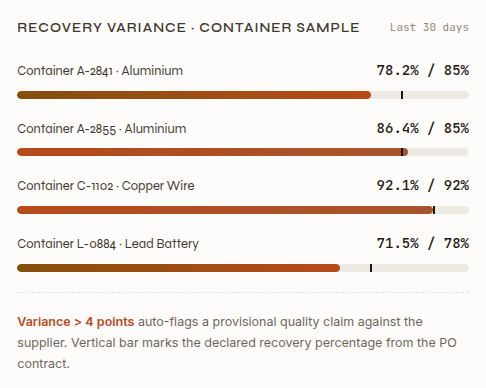
A container declared at 85% aluminium recovery delivers 78%. Without a system-level yield ledger, that 7-point gap absorbs into manual cost adjustments, vendor performance becomes a guess, and the procurement team loses the data to negotiate the next purchase.
Impact: Direct margin erosion per container
Liquid Metal is a Vanishing Asset
Aluminium delivered molten to industrial consumers must be cast, invoiced, e-way-billed, and gate-passed within 2–4 hours. A single e-Invoice failure at 9 PM, an IRN sync glitch, or a Master GSP outage during night shift translates directly into solidified, lost inventory.
Impact: Total loss of finished product
BOM-Driven Subcontracting Doesn't Work
Standard subcontracting modules expect a fixed input-output ratio. When you ship 10 tons of Material A to a vendor and receive back a variable mix of Material B, BOM-based subcontracting fails. You need on-the-fly input-output linkage at the transaction.
Impact: Lost job work traceability
Manual Cost Definition Creates Audit Gaps
When manufacturing cost is keyed in manually at output — without a rollup from raw material consumption, energy, labour, and scrap loss — yield variance and production losses become invisible to the accounting layer. Auditors flag this. Margin reports become unreliable.
Impact: Cost-of-production audit risk
Work-in-Progress has Nowhere to Live
When manufacturing collapses three stages into one MO, work-in-progress disappears from the stock ledger. Material that is ``in the furnace`` is neither raw nor finished. Without WIP visibility, planners can't react to delays and finance can't value mid-run inventory.
Impact: Production visibility blind spot
Recovery Tracking Lives in Spreadsheets
Container-by-container recovery percentages, vendor scorecards, batch-level yield curves — most plants track these in Excel. The data exists, but it never reaches production planning, vendor negotiation, or financial reporting in time to change a decision.
Impact: Decision-grade data, lost
KEY FEATURES
Every feature shaped by metal recycling operations
No generic manufacturing language. Every capability below was built in response to a specific operational pattern observed on the plant floor — from import-scrap MRN to liquid-metal dispatch.
Manufacturing Order — With or Without BOM
- BOM-driven MO for standardised alloy production
- BOM-less MO for variable-input recycling runs
- Order types: domestic, raw material, finished goods
- Operating-unit-wise MO sequencing
- FIFO stock consumption on raw material
Group-Based MO Approval Hierarchy
- Up to 3 configurable approval levels
- Value-band and unit-based routing
- Sequential clearance — Level 1 then Level 2
- Override permitted with logged justification
- Audit-grade approval log (parallel to chat)
MO Order Creation
- Manual cost entry for variable-yield production
- Weighted average raw material costing
- LME-linked input cost on unpriced PO tranches
- Cost approval before warehouse transfer
- Manufacturing cost list with revision history
Vendor & Customer Job Work
- Customer Job Work — inbound material, outbound finished
- Vendor Job Work — outbound, vendor converts, inbound
- On-the-fly input-output linkage per transaction
- Job Work charge — input-based or output-based
- Returnable gate pass linkage for outward dispatch
Job Work Charges, Freight & Return Date
- Per-process or per-unit charge configuration
- Input-based vs output-based charge calculation
- Expected return date with delay flagging
- Inward/outward freight charge tracking
- Pre-close approval for partial completion
Multi-Company & Multi-Operating Unit
- Multi-legal-entity operation on one platform
- Operating-unit-wise sequence numbering
- Inter-company stock transfer with e-Way Bill
- Entity-specific approval hierarchy
- Consolidated and entity-level reporting
Quality Inspection & Claim Linkage
- QC checkpoint on raw material receipt (MRN)
- QC checkpoint on finished output
- Provisional → Final → Settled claim workflow
- Lot-level claim linkage to MO
- Approval-controlled credit/debit note generation
Lot, Serial & Container Traceability
- Auto-generated lot numbers on MRN
- Lot tracking on raw material and finished goods
- Container ID propagation through production
- Backward trace: MO → MRN → ASN → Container → PO
- Forward trace: MO → Stock → Sales → Invoice
Real-Time Stock Consumption & Transfer
- Live raw material consumption on MO confirmation
- Auto stock transfer to production warehouse
- FIFO-based scrap consumption
- Min-max replenishment monitoring
- Multi-warehouse, multi-location aware
MANUFACTURING WORKFLOW
From imported scrap to dispatched ingot — one continuous chain.
The end-to-end manufacturing lifecycle, as it actually runs on the floor. Every step links forward and backward, with no manual handoffs between systems or spreadsheets.
-
01
Scrap Receipt
ASN → MRN → Lot
-
02
Quality Inspection
Recovery % verified
-
03
Production Planning
Min-max replenishment
-
04
Work Center
Smelt · Clean · Hull
-
05
Finished Goods
Ingot · Sheet · Liquid
JOB WORK MANAGEMENT
Subcontracting that works both ways — without forcing a fixed BOM.
Job work in recycling moves in two directions. Customers ship material in for conversion; vendors receive material for processing and return it transformed. The platform handles both as first-class workflows with full traceability and gate-pass linkage.
Outbound Material, Vendor Conversion, Return
Send Material A to a vendor — typically when specialised processing capacity exists outside the plant. Vendor processes and returns Material B. The Job Work Order anchors the in-out transformation; charge is settled as a Service PO.

- Order Creation: JWO sequence per operating unit; multi-level approval based on amount
- Inward Update: Add inward lines and update quantities post-approval as material returns
- Recovery %: Line-level recovery percentage capture for variance analysis
- Charge Basis: Job work charge configurable per input quantity or per output quantity
- Gate Pass: Returnable gate pass on outbound; inbound gate pass on receipt
- e-Way Bill: Auto-generated on both outbound dispatch and inbound return
- Pre-Close: Partial completion supported when balance material is no longer required
Inbound Customer Material, Internal Conversion, Outbound Finished
Customer ships raw material to the plant for conversion. The Group processes — say, scrap to ingot, sheet to coil — and dispatches finished output back. Material remains the customer’s property throughout; no inventory ownership transfer occurs.

- Inbound MRN: MRN raised against Customer JWO — not against a Vendor PO
- Ownership: Inventory belongs to the customer; no asset transfer to Metal Recycling
- Conversion: Internal processing tracked through standard MO with lot linkage
- Output Dispatch: Delivery Order, e-Invoice, e-Way Bill on finished goods return
- Service Invoice: Conversion charge invoiced separately as service
- Challan View: Smart-button view of all Job Work Challans against the JWO
- Department Mapping: Track which department handled the conversion run
QUALITY & RECOVERY TRACKING
Recovery variance becomes a measurable signal — not absorbed cost.
The single most important number in metal recycling is the gap between declared and actual recovery. The platform makes that gap visible, attributable, and actionable — by container, by vendor, by furnace, by batch.
Every imported scrap consignment carries a declared recovery percentage in the purchase contract — for example, 85% on an aluminium consignment. The actual recovery from the smelter rarely matches exactly. A 7-point shortfall on a 20-ton container represents 1.4 tons of finished metal that the cost layer expected but never received.
The platform captures recovery at three points: at MRN (against the visual inspection and weight), at QC (against laboratory verification), and at MO close (against actual furnace output). Variance at any stage triggers the appropriate workflow — Provisional Claim against the supplier, internal investigation, or production review.
The data feeds the Vendor Scorecard, where consistent under-recovery from a specific supplier becomes negotiation leverage on the next purchase. It feeds the Yield Variance Report, where planned vs actual recovery by container drives procurement decisions. And it feeds the Live Production Yield Dashboard, where furnace-by-furnace yield in real time is critical for liquid-metal dispatch sensitivity.
- Three-stage Quality Claim — Provisional, Final, Settled — with approval gating
- Quality Claim Aging report — open claims by stage with aging buckets
- Lot-level claim linkage to MO, MRN, and originating PO
- Internal credit notes routine; external customer credit notes require higher approval
- Live furnace yield dashboard for night-shift liquid metal monitoring
INVENTORY & LOGISTICS INTEGRATION
Production doesn't end at the furnace — it ends at the truck.
The manufacturing module is wired directly into stock, container, gate pass, and e-way bill workflows. The moment a batch closes, the dispatch pipeline is ready. The moment a vehicle leaves the gate, the inventory ledger reflects it.
Inventory Integration
- FIFO-based raw material consumption — oldest scrap stock consumed first to manage demurrage and ageing exposure
- Real-time stock updates on both source and destination warehouses — no lag, no end-of-day batch sync
- Auto stock transfer from production line to finished goods warehouse on MO close
- Min-max replenishment monitoring on finished goods — production planners see the gap before it becomes a stockout
- Lot/serial integrity preserved across stage transitions — Smelting → Cleaning → Hulling
- Multi-warehouse and multi-store-location aware for plant-wide stock visibility
- Unbuild order reverses inventory cleanly — finished stock back to raw, with audit-locked traceability
Logistics Integration
- Container ID propagates from ASN through MRN, production, and into finished goods — backward traceability on demand
- Gate Pass mandatory for every inbound and outbound movement — no manual override on dispatch
- e-Way Bill auto-generated on inter-unit transfer where kilometre threshold applies
- e-Invoice IRN generation integrated with Master GSP, with fallback to direct IRP for outage scenarios
- Vehicle gate-in / gate-out captured against the Delivery Order and Manufacturing Order references
- Transporter and vehicle number auto-captured on outbound dispatch from gate entry
- Liquid metal dispatch window — 2–4 hour clock starts at MO close; full digital trace ends at gate-out
COSTING & FINANCIAL INTEGRATION
Production cost that holds up to audit
Metal recycling cost is not a textbook BOM rollup. It blends LME-linked unpriced PO tranches, weighted-average raw material cost, freight, RCM on transporters, and a manual cost adjustment at output that approval-controls the margin. The platform handles all four layers.

LME-Linked Raw Material Cost
Imported scrap arrives under Priced or Unpriced POs. For unpriced parent orders, individual tranches are fixed against LME rates over time. Each tranche becomes a child Priced PO.

Weighted Average Costing
When multiple containers of the same scrap category land at different rates, weighted average becomes the consumption cost on the MO. The platform handles the moving average automatically as new MRNs land.

Input/Output Based Job Work Charge
Vendor job work cost is configurable two ways — per unit of input dispatched, or per unit of output received. The basis is locked at JWO creation, eliminating the ambiguity that drives reconciliation disputes.

Manual Cost at Output
For variable-yield runs, the user defines manufacturing cost at output. Approval is mandatory before the MO closes and the produced quantity transfers to the production warehouse. Cost revisions carry full audit history.

RCM on Transporter Freight
Inbound freight on raw material attracts Reverse Charge Mechanism — GST is the recipient’s responsibility. The platform recognises the RCM tax line, posts it correctly to the GL, and flows it into the GST return reconciliation.

Auto Accounting Posting
Every MO confirmation, every Unbuild Order, every job work return triggers an automatic journal entry — raw material credit, WIP debit, finished goods debit, cost-of-production credit. No nightly batch posting, no manual journal vouchers.
DASHBOARDS & REPORTS
Production intelligence — not month-end exports.
Real-time visibility into yield, cost, and operational risk. The reports management actually opens, delivered when they actually matter.

Live Production Yield Dashboard
Furnace-by-furnace yield in real time. Critical for liquid-metal dispatch sensitivity where deviation matters within the hour.
Yield Variance Report
Planned vs actual recovery percentage by vendor and by container. The basis of vendor performance scoring and next-purchase negotiation.

MO Status Summary
Draft, confirmed, in-progress, done. Operating-unit-wise breakdown with approval-pending highlight for managers.
Manufacturing Cost Register
Cost per MO with revision history. Manual overrides flagged. Approval trail attached. Audit-ready.
Vendor Scorecard
Yield performance, quality claim exposure, on-time delivery, demurrage cost attribution — per supplier, rolling 12 months.

Job Work Tracking
Open job work orders by vendor and customer, with expected return dates, inward-pending quantities, and aged exposures.

Replenishment Status
Finished goods inventory against min-max thresholds. Items below min flagged for production planning; items above max held back.

e-Invoice Failure Log
IRN generation failures with error codes, resync status, and resolution — critical during night-shift liquid metal dispatch.

Furnace Utilisation
Machine-level utilisation, idle time, and throughput per furnace. Identifies plant bottlenecks before they hit dispatch.
