Purchase Built for the Complexity of Metal
From LME-linked unpriced POs and container-level ASN tracking to three-stage quality claims and import licence management — every procurement workflow your metal recycling business actually runs.
INDUSTRY REALITY
Purchase in Metal Recycling is not a Standard Process
Generic ERP systems are built for stable, predictable supply chains. Metal recycling procurement is none of those things. Here is what your team actually deals with every day.

LME Volatility Erodes Margins Daily
Copper, aluminium, lead and nickel prices shift every hour on the London Metal Exchange. Without a system that links purchase price to LME rate at the moment of commitment, your procurement team is operating blind — buying high and locking losses into every container.

Container Management Is a Manual Nightmare
A single import shipment can arrive as six separate containers with different products, weights, and quality classifications. Tracking each container from Bill of Lading through customs clearance to plant receipt — in one connected system — is something most ERPs simply cannot do.

Declared vs Actual Yield Creates Financial Exposure
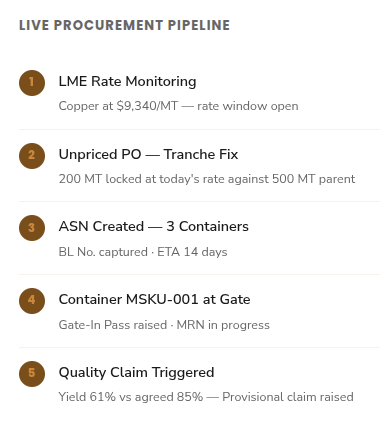
When a Chinese supplier commits to 85% copper recovery and your plant breaks down the scrap to find 61%, you have a significant commercial dispute on your hands. Without a structured quality claim workflow, that variance either goes unrecovered or turns into a months-long manual negotiation.

Import Compliance Requires Precision at Every Step
Bill of Entry registration, import licence debit, customs duty allocation, freight forwarder billing under RCM — each of these steps must be executed correctly and linked to the originating purchase order. A single missed linkage creates audit exposure and GST reconciliation nightmares.

Demurrage Costs Accumulate Silently
Every day a container sits at port beyond its free time costs real money. Without automated tracking and escalation alerts, containers go unmonitored and demurrage charges quietly compound — costs that are entirely avoidable with visibility and timely action.

Budget Leakage Through Uncontrolled Purchasing
When procurement, plant operations, and finance teams operate across different systems or spreadsheets, budget overruns go undetected until period-end. Project-based procurement, capital purchases, and general supplies all need budget allocation, approval routing, and real-time tracking against sanctioned limits.
-
Project Budget
-

Purchase Indent
-

LME Rate Monitoring
-

Purchase Order
-
ASN & BL Capture
-

Container Tracking
-

Customs & Bill of Entry
-

Gate-In Pass
-

MRN / GRN Receipt
-

Quality Verification
-

Vendor Bill
-

Payment Request
-

Settled & Closed
Every stage is linked, auditable, and approval-governed. No transaction moves forward without the previous step being correctly completed.
CORE CAPABILITIES
Purchase Features That Understand How Metal Businesses Actually Work
Designed not by software generalists but by consultants who have spent years inside metal recycling plants, trading floors, and import docks.

LME-Linked Pricing & Unpriced PO
Raise a parent Unpriced PO for your full committed tonnage, then fix rates in tranches as the LME moves in your favour. Each tranche becomes a child priced order — your hedging strategy lives inside your procurement workflow.

Container-Level ASN Management
Capture Advance Shipment Notices at container granularity — product breakdown, weight, metal content percentage, and expected arrival date for every container in the shipment. When cargo lands, the ASN drives your MRN with zero rekeying.
Internal & External Weightment
Record in-plant weighbridge readings alongside external third-party weighment data for every MRN. The system tracks both, flags variances, and carries the net verified weight into vendor billing and quality claim calculations automatically.

Import Licence Tracking & Renewal
Every import receipt debits your licence balance in real time. The system monitors validity dates, raises alerts when consumption approaches the limit, and tracks the cost difference between renewal and fresh licence acquisition.

Bill of Entry & Customs Integration
Register your Bill of Entry number against the MRN transaction, ensuring customs duty is correctly captured in the landed cost layer. The BoE-to-MRN linkage creates the complete audit trail your import documentation requires.

Multi-Currency & Multi-Entity Procurement
Handle USD, EUR, CNY and other currencies natively across import orders. The system converts at the rate prevailing at PO, ASN, and billing stages separately — giving you accurate forex exposure at every transaction point.

Recovery Percentage & Yield Tracking
Capture the supplier's committed recovery percentage at PO stage and compare it against the actual yield measured at breakdown. The variance is the commercial basis for your quality claim — calculated, documented, and ready for negotiation.

Demurrage Alerts & Container Holding Reports
The system tracks free-time windows for every container and auto-escalates to senior authority when 75% of free time is consumed. Daily container holding reports are emailed automatically so your team is never caught by a demurrage surprise.

Vendor Bill with Multi-GRN Linkage
Match a single vendor bill against multiple MRNs from the same purchase order. Once a GRN is invoiced, it drops from the selection list — preventing double billing. The linkage between receipt and bill is maintained end-to-end for GST input credit accuracy.
PURCHASE ORDER TYPES
Every Purchase Scenario Has Its Own Order Type
Metal recycling businesses don't buy everything the same way. The ERP supports six distinct purchase order types, each with its own approval path, compliance requirements, and stock treatment.

Import Purchase Order
High Complexity · Primary Value Driver
The cornerstone of non-ferrous recycling procurement. Import POs are created in foreign currency against overseas scrap suppliers, linked to freight forwarders via Incoterms, and carry the full LME-pricing mechanism. From PO placement through ASN capture, Bill of Lading registration, customs clearance, and container-level MRN — every step is governed, linked, and tracked. Import licence debit is automatic at receipt.

Domestic Purchase Order
GST Domestic · Standard GRN Flow
Used for domestic scrap procurement, general supplies, and consumables from Indian vendors. Supports both priced and unpriced variants, includes TDS applicability prompts, and follows the standard GRN-to-vendor-bill flow with e-Way Bill generation for qualifying inter-state movements.

High Seas (ICS) Purchase
On-Sea Title Transfer · Zero Plant Stock
A unique instrument where Metal Recycling acquires cargo while it is still on international waters and simultaneously sells it to a real consignee without the goods ever entering the plant. The ICS Purchase is mapped 1:1 to an ICS Sale, and the margin is captured in a dedicated accounting nominal code. No gate pass, no MRN, no plant stock movement.

Service Purchase Order
Freight Forwarders · Maintenance · RCM
Handles procurement of services — freight forwarding charges, repair and maintenance, third-party weighment, and other service engagements. RCM applicability is automatically flagged for transporter bills, ensuring Reverse Charge tax is correctly applied. Service POs link to RGP gate passes where equipment is involved.

Unpriced Purchase Order
LME Tranche Fixing · Hedging by Lot
The most sophisticated procurement instrument in the system. A parent Unpriced PO holds the total committed quantity with no fixed rate. As LME moves to a favourable position, the procurement team locks tranches — 100 MT today, 200 MT next week — each becoming a child priced PO. The draft pricing mechanism holds until the tranche fix is confirmed.
General & Project Purchase Order
Budget-Controlled · Capital & Infra Spend
Used for capital equipment, civil works, and project-specific material procurement (steel, cement, construction inputs). All project POs are linked to sanctioned budget allocations through the Purchase Indent. Consumption against budget is tracked in real time, with multi-level approval enforcement at every value band.
LME-BASED PURCHASE
Buy at the Right Price, Every Time
The London Metal Exchange determines the commercial value of every ton of copper, aluminium, lead, and nickel you process. Your ERP should not just record purchases — it should support the strategic timing decisions your team makes every day at the trading desk.

Continuous Rate Monitoring Support
The system captures LME rates at the time of tranche fixing, creating an immutable price record for every committed quantity. Your procurement team monitors the market and acts; the ERP ensures every decision is timestamped and auditable.

Tranche-Level Price Commitment
Order 500 MT under a single Unpriced PO. Lock 100 MT at Monday's rate, 200 MT on Wednesday when the LME dips further, and the balance when conditions are right. Each lock produces a child priced PO with full lineage back to the parent order.

Hedging Buy & Sell Mapping
Map LME hedging positions against actual procurement and sales transactions. Track open hedge exposure, broker margin updates, and LME settlement entries — providing your treasury team with the data they need to manage commodity price risk with precision.
Weighted Average Pricing for Scrap
Incoming scrap consignments arrive with varying metal content percentages. The system supports weighted average pricing across multiple containers within a single shipment, correctly blending the cost basis for inventory valuation and margin reporting.
ASN & CONTAINER MANAGEMENT
Full Visibility from Vessel to Plant Gate
When your cargo leaves Shanghai, your ERP should already know what is on each container, when it is expected to arrive, and what compliance steps are needed before it can move from port to plant.
STAGE 1
Bill of Lading Received
Freight forwarder sends BL number with container-level breakdown — product, weight, grade, and metal content percentage per container. BL is entered into the system as the trigger for ASN creation.
STAGE 2
ASN Created at Container Level
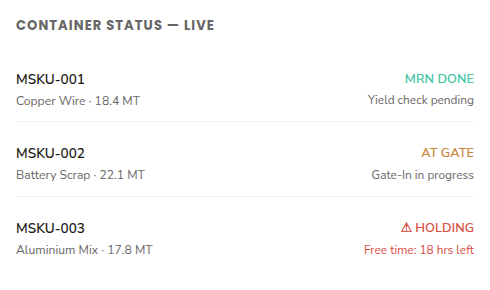
Three containers entered separately: MSKU-001 (18.4 MT copper wire scrap), MSKU-002 (22.1 MT battery scrap), MSKU-003 (17.8 MT aluminium mix). Expected arrival date captured. No stock movement at this stage — it is a forward notice only.
STAGE 3
Customs Clearance & Bill of Entry
Customs broker files Bill of Entry at port. BoE number is entered into the ERP against the ASN. Import licence is automatically debited by the cleared weight. Freight forwarder's customs handling bill is raised as a Service PO with RCM applicability.
STAGE 4
Gate-In Pass & MRN per Container
Truck arrives at plant. Security raises Gate-In Pass capturing vehicle number and ASN reference. Container is unloaded and one MRN is posted per container — internal and external weighment data recorded. MRN is mandatory linked to Gate-In Pass before stock is posted.
PRE-CLOSE MECHANISM
When Containers Arrive Short
Import shipments rarely deliver 100% of the booked quantity. If a container booked at 24 MT delivers 20 MT, the system's pre-close mechanism allows the procurement team to formally cancel the remaining 4 MT — with an audit reason — and close the PO line against actual receipt. Re-importing 4 MT costs more than the metal is worth. The system supports the decision without forcing a workaround.
MRN / GRN RECEIVING WORKFLOW
From Unloaded Container to Verified Stock
The receiving process is where import compliance, inventory accuracy, and quality governance converge. The system enforces the correct sequence — no stock is posted without a valid gate pass, no vendor bill is raised without a confirmed receipt, no quality claim is opened without a verified MRN weight.
MRN with ASN (Import Containers)
Container-specific receipt mapped to ASN, PO, and Bill of Entry. Mandatory Gate-In Pass linkage. Internal and external weighment fields. Lot number auto-generated. One MRN per container is enforced — there is no shortcut that allows a single MRN to absorb multiple containers and blur the audit trail.

MRN — Domestic Raw Material
Raised against domestic scrap purchase orders. Simpler flow — no ASN dependency — but still carries gate pass linkage, machinery tracking (which weighbridge was used), and multi-level approval before stock is posted.
GRN — General & Store Items
Used for procurement of non-raw-material items — stationery, consumables, spare parts, and general supplies raised through Material Requisition or General Purchase Indent. Follows a lighter approval path while maintaining the same receipt-to-bill linkage discipline.
SRN — Service Receipt Note
Acknowledges completion of services purchased through Service PO — freight forwarding charges, maintenance work, and outsourced operations. The SRN is the trigger for service vendor billing, with RCM tax automatically flagged for qualifying transporter services.
QUALITY CLAIM MANAGEMENT
Recover What You Are Owed.
Every Time.
The gap between a supplier's declared metal recovery percentage and the actual yield at your plant is one of the most significant margin leaks in recycling procurement. The system's three-stage claim process ensures that variance is documented, negotiated, and settled with complete financial traceability.

Provisional Claim
Raised immediately when the breakdown at plant reveals a yield below the agreed recovery percentage. The provisional claim captures the MRN reference, the committed percentage, the actual measured yield, and the indicative commercial value of the shortfall. Vendor is formally notified and negotiation is opened.

Final Claim
After detailed sample testing and physical assessment, the final yield figure is confirmed. The Final Claim is raised against the Provisional Claim, with the provisional data auto-populated. The procurement team enters the final claim amount and the proposed percentage of recovery to be claimed from the vendor. Both parties negotiate to this number.

Settlement Claim & Debit Note
Once both parties agree, the settled amount is entered into the system as a Settled Claim, and a Debit Note is raised against the vendor's account for the agreed shortfall. The system calculates the settled claim percentage automatically, closes the claim cycle, and the vendor's outstanding balance is adjusted. The full audit chain from MRN through to Debit Note settlement remains intact for GST compliance.
COMPLIANCE & IMPORT MANAGEMENT
Every Regulatory Obligation. Built Into the Process.
Import procurement in India is one of the most compliance-dense processes in manufacturing. The system handles every obligation without requiring your team to manage it manually.
Bill of Entry Management
BoE number registered against the ASN at customs clearance stage and linked to the downstream MRN. Customs duty is automatically allocated into the landed cost layer of the inventory. The BoE-MRN linkage is mandatory — receipts cannot be posted without it, ensuring every import has a complete documentation trail.

Import & Export Licence Control
Licences carry a quantity balance (e.g. 1,000 MT authorised). Every import receipt debits the balance. The system warns when the balance approaches zero and tracks the validity expiry date — ensuring renewal happens before exhaustion rather than after a compliance breach.

Reverse Charge Mechanism (RCM)
Freight forwarder and transporter service bills are automatically flagged for RCM applicability. The system raises a dedicated RCM Bill class, calculates the GST liability on behalf of the service provider, and ensures it is paid to the government while preserving the input credit entitlement.

TDS on Vendor Bills
TDS applicability is prompted at the time of vendor bill processing based on vendor classification. The system suggests the correct TDS percentage (194Q and other applicable sections), flags when the user intends to override, and maintains a complete TDS deduction register for quarterly filings.

Incoterm & Port Master Management
Source and destination ports are selected from a comprehensive global port master, supporting freight calculation and export documentation. The agreed Incoterm is captured at freight forwarder agreement level, correctly determining who bears freight, insurance, and at which point title and risk transfer.
e-Way Bill for Inter-Plant Transfers
Stock movements between plant locations (Gummidipoondi to Madhavaram, for example) are evaluated against the kilometre threshold under GST. Where the threshold is crossed, e-Way Bill generation is mandatory before the stock transfer is confirmed — protecting against detentions and fines on internal logistics.
REPORTS & DASHBOARDS
Procurement Intelligence That Actually Drives Decisions
Scheduled reports reach senior authority automatically every morning. Drill-down analysis gives your procurement team the commercial intelligence they need to act before problems become costs.
Purchase vs Indent Report
Track how much of each sanctioned indent has been converted to POs and received — by department, by project, and by period.
Container Holding Report
Daily auto-email to logistics head and senior authority. Shows every container in holding status, free-time remaining, and estimated demurrage exposure.
ASN Pending & Arrival Report
Full view of all shipments in transit — container count, expected arrival date, metal content, and associated PO reference for each vessel.
Yield Variance Dashboard
Vendor-by-vendor and container-by-container comparison of declared versus actual recovery percentage — the foundation for supplier accountability.
Quality Claim Aging Report
Open claims by stage (Provisional / Final / Settlement) with days-outstanding buckets. Surfaces claims that are at risk of expiring without resolution.
Licence Balance Report
Real-time import and export licence consumption, remaining balance, and validity expiry dates — with renewal-due alerts configurable per licence.

LME Hedging Position Report
Parent Unpriced PO versus locked tranches — committed tonnage, locked rates, weighted average cost, and open exposure for each metal group.
Budget Utilisation Report
Real-time budget consumption by department, project, and purchase category — flagging categories approaching exhaustion before the next purchase is committed.
BUSINESS BENEFITS
What Changes When Procurement Has the Right System
Commodity Price Risk — Controlled
Tranche-level LME fixing stops procurement teams from buying entire seasons of scrap at unfavourable rates. The Unpriced PO structure gives you the framework to buy in windows, spreading price exposure across the LME cycle with every fix decision documented and linked to inventory cost.
Demurrage Costs — Eliminated
Automated escalation alerts at 75% of free-time consumption, daily container holding reports to senior authority, and gate-to-MRN timing tracking together remove the silence that lets demurrage accumulate. What was previously discovered at month-end is now visible in real time.
Yield Variance Recovery — Systematic
Every quality shortfall is captured, documented, and pushed into the claim workflow automatically. The three-stage process ensures no variance goes unnegotiated. Vendors know they will be held to their committed recovery percentages every time — and that accountability changes supplier behaviour.

Import Compliance — Airtight
BoE-to-MRN linkage, licence balance real-time debit, and RCM billing automation remove the manual steps that create compliance gaps. Your GST input credit reconciliation, customs documentation, and licence renewal management are driven by transaction data — not spreadsheets maintained by one person.

Procurement Governance — Visible
Three-level approval, payment request gate, budget tracking against indent, and immutable audit log mean that unauthorised commitments, informal phone-call agreements with vendors, and over-budget purchases are structurally prevented — not just discouraged by policy.

Vendor Accountability — Data-Driven
Yield history, quality claim frequency, on-time delivery, and demurrage attribution by vendor give your procurement team a factual basis for supplier selection and negotiation. The system produces the evidence — your team uses it to negotiate better terms on the next order.