How Activity Dimension Works in iDempiere
The Activity Dimension tracks internal operational work that doesn’t naturally belong to products, customers, or projects. It classifies costs and revenue by activity type—such as administration, maintenance, logistics, or internal services—and is intentionally selected by users for precise accounting control.
Creating Activity Dimension Values
Activity Dimension values are created as Activity records in the system. Each activity represents a type of work or operational function.
When creating an activity:
- The Activity must be Active
- It should represent a clear internal function or purpose
- It should be created before related transactions are entered
Activities can be grouped hierarchically, but accounting postings are always done at the individual activity level.

Activity Hierarchy and Structure
The Activity Dimension supports a parent–child hierarchy.
- Parent activities are used for grouping and reporting
- Child activities represent actual operational work
- Posting is allowed only on leaf-level activities
This structure allows reports to show detailed activity-level costs as well as summarized views across multiple activities.
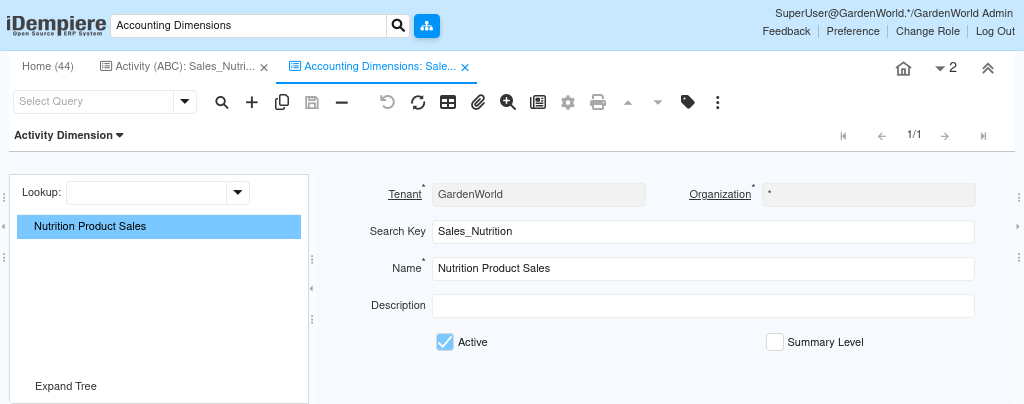
Activity Dimension During Transactions
The Activity Dimension is typically selected manually during transaction entry.
Users assign an activity when:
- Posting internal expenses
- Creating GL journals for allocations or adjustments
- Recording operational costs not tied to products or projects
Once selected and the document is posted, the activity reference becomes part of the accounting entry and cannot be changed.

Activity Dimension in Accounting Records
After posting, the Activity Dimension appears in Accounting Fact Details along with other dimensions.
This allows:
- Tracking costs by internal activity
- Reviewing operational expense patterns
- Supporting internal cost allocation analysis
Historical entries remain unchanged even if activities are later deactivated.
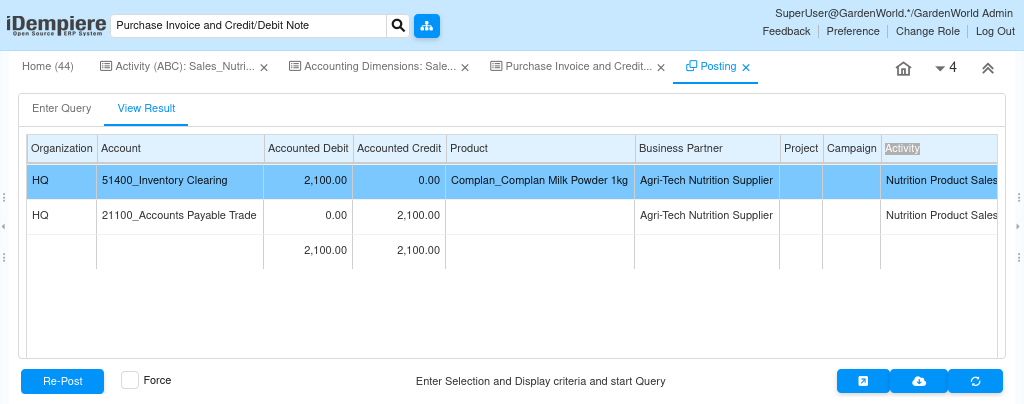
Accounting Schema and Dimension Posting (Applies to All Dimensions)
Accounting Dimensions in iDempiere only appear in accounting entries when they are enabled in the Accounting Schema. Creating a dimension and using it in transactions is not enough by itself. Each Accounting Schema has a dedicated Accounting Dimensions tab. This tab controls which dimensions are allowed to post values into accounting records. The schema acts as a gatekeeper between operational data and financial postings.
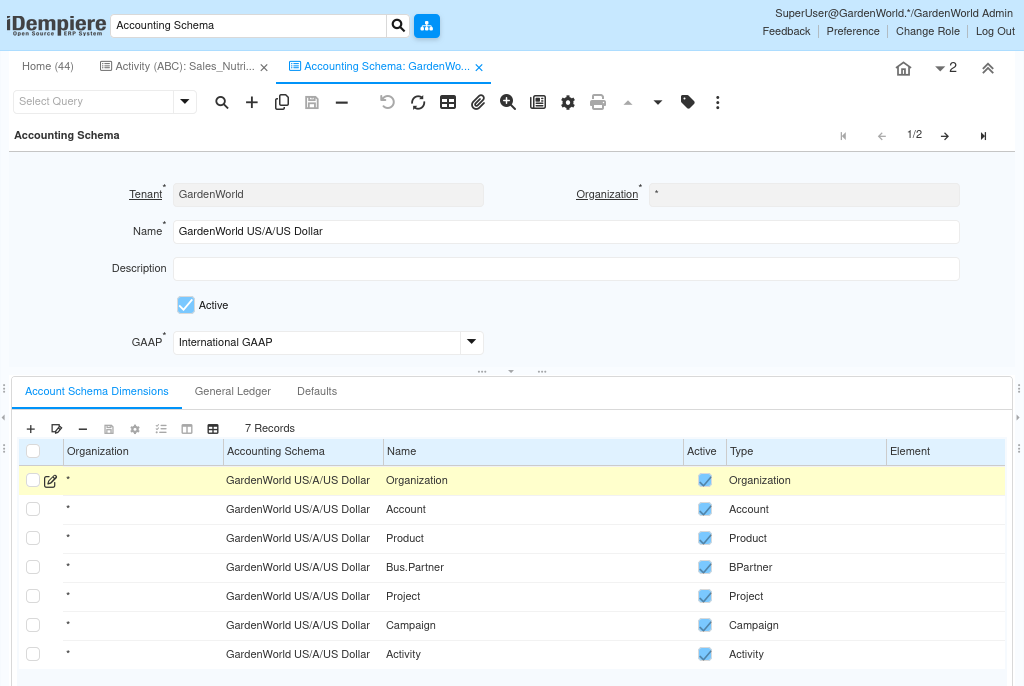
When a dimension is enabled in the Accounting Schema, iDempiere stores the selected dimension value during posting. The value becomes visible in Accounting Fact Details and can be used in financial reports, analyses, and audits.When a dimension is not enabled, transactions still work normally. Documents can be completed, and business processes continue without error. However, the dimension value is ignored during posting, and accounting entries do not contain that dimension.
This design allows organizations to control accounting complexity. Dimensions can be introduced gradually, activated only when reporting or tracking is required, without changing operational workflows.
Key points to remember:
- Dimensions must be enabled per Accounting Schema
- Posting behavior depends on the schema used by the document
- Existing transactions are not retroactively updated
- Different schemas may enable different dimensions
Always confirm the Accounting Schema configuration before validating dimension behavior in accounting or reports.
Activity Dimension in Reporting
Reports use the Activity Dimension to present operational views of financial data.
Common reporting scenarios include:
- Administrative costs by activity
- Maintenance or logistics expense analysis
- Internal function cost summaries
Because the dimension supports hierarchy, reports can roll up multiple activities into a single summary view.
Outcome
With the Activity Dimension correctly used, iDempiere provides clear visibility into internal operational costs. Users classify transactions intentionally, accounting remains structured, and reports reflect how the organization actually operates internally.