How Closure and Finalization of RFQ Works in iDempiere
The Close RFQ action formally ends the RFQ lifecycle in iDempiere. It locks the RFQ, finalizes all responses, and marks sourcing as complete, separating vendor evaluation from execution while preventing late changes or inconsistent downstream processing.
RFQ Ready for Closure
Before closing an RFQ, the system expects that the sourcing decision is already complete. Typically, this means RFQ responses are collected, reviewed, and—if required—ranked and marked with a selected winner. At this stage, purchase orders or sales orders may already be created, but the RFQ itself remains open until explicitly closed.
This design allows procurement teams to finish execution documents first and then formally seal the RFQ.
Key readiness indicators:
- RFQ responses are created and evaluated
- Winning response is identified (manually or via Rank Responses)
- No further vendor input is expected
Close RFQ Process Execution
The Close RFQ process is triggered from the gear (Process) menu on the RFQ header. When selected, the system opens the close RFQ and responses dialog. This dialog controls how the closure is executed and how stakeholders are informed.
The process can be run immediately or scheduled as a background job. When run as job is enabled, the system executes closure asynchronously and sends a notification to the process owner once completed.
Dialog controls include:
- Run as Job – Executes closure in background
- Notification Type – Defines how closure status is communicated (e.g., Email)

System Actions During RFQ Closure
Once the close RFQ process runs successfully, iDempiere performs a coordinated set of system updates. These updates ensure data integrity across RFQ, RFQ responses, and downstream documents.
The RFQ is marked as processed, which immediately blocks:
- New RFQ responses
- Changes to RFQ header
- Changes to RFQ lines and quantities
At the same time, all linked RFQ responses are finalized. No response—winner or non-winner—can be edited further. This guarantees that procurement decisions remain auditable and stable.
System effects applied automatically:
- RFQ processed checkbox is set
- RFQ becomes read-only
- All RFQ responses are locked
- Process completion message is logged and notified
RFQ State After Closure
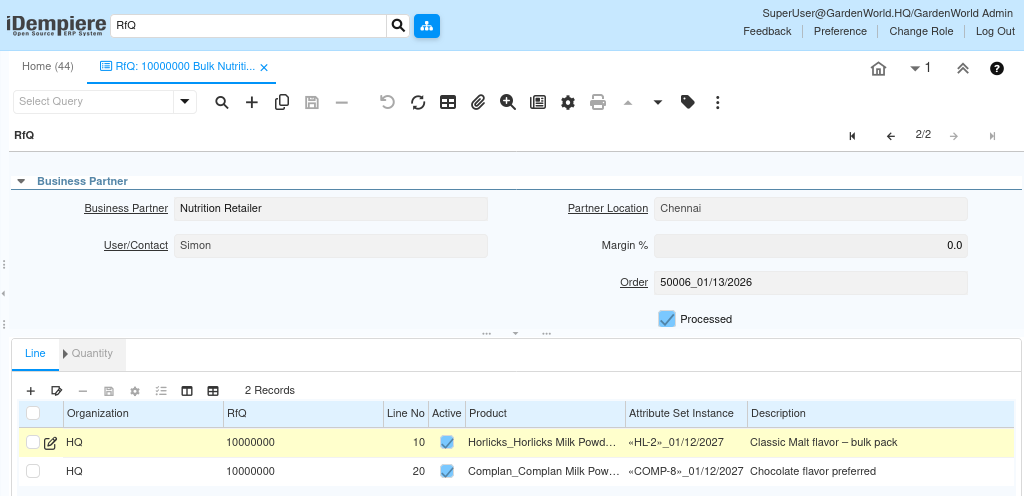
After closure, the RFQ remains visible for reporting, traceability, and audit purposes, but it is no longer part of active operations. Users can still open the RFQ to review details, responses, rankings, and linked documents such as purchase orders or sales orders.
The processed indicator clearly signals that the RFQ lifecycle has ended. This distinction is essential in environments with recurring or cooperative RFQs, where historical RFQs must not be reused unintentionally.
Purpose of Closing RFQ
Closing an RFQ enforces commercial discipline. It ensures that once sourcing decisions are finalized, the organization moves forward with execution instead of revisiting negotiations or allowing late changes.
From a governance perspective, this step creates a clean boundary between:
- Sourcing phase (RFQ, responses, evaluation)
- Execution phase (purchase orders, sales orders, logistics, invoicing)
It also supports audit and compliance requirements by preserving a frozen snapshot of the RFQ decision.
Use Cases
- Preventing vendors from submitting late quotations
- Locking RFQ data after winner selection
- Finalizing sourcing cycles for audit or compliance
- Ensuring RFQs are not reused in future cycles
- Supporting clean reporting for answered vs. closed RFQs
Outcome and System Integrity
After an RFQ is closed:
- Procurement decisions are finalized
- Downstream documents remain valid and traceable
- Reporting reflects accurate RFQ status
- Data integrity is preserved across purchasing and sales
The close RFQ action ensures that iDempiere treats the RFQ as a completed sourcing artifact, not an active transaction. This keeps procurement workflows predictable, auditable, and operationally safe.
In the RFQ lifecycle, close RFQ is the final control gate that confirms the sourcing process is finished and the organization has fully moved into execution and fulfillment.