How Vendor Selection Works in iDempiere
Vendor selection defines how iDempiere manages multiple suppliers for the same product. It keeps vendor choice flexible and evaluates price, availability, and delivery at purchase time, helping procurement teams compare options and select the most suitable vendor before creating a purchase order.
Product–Vendor Relationship
Vendor selection begins at the product level.
A product must be connected to one or more vendors before any comparison is possible.
These relationships are maintained in the Product → Business Partner tab. Each record represents a valid supplier for that product and confirms that purchasing from this vendor is allowed.
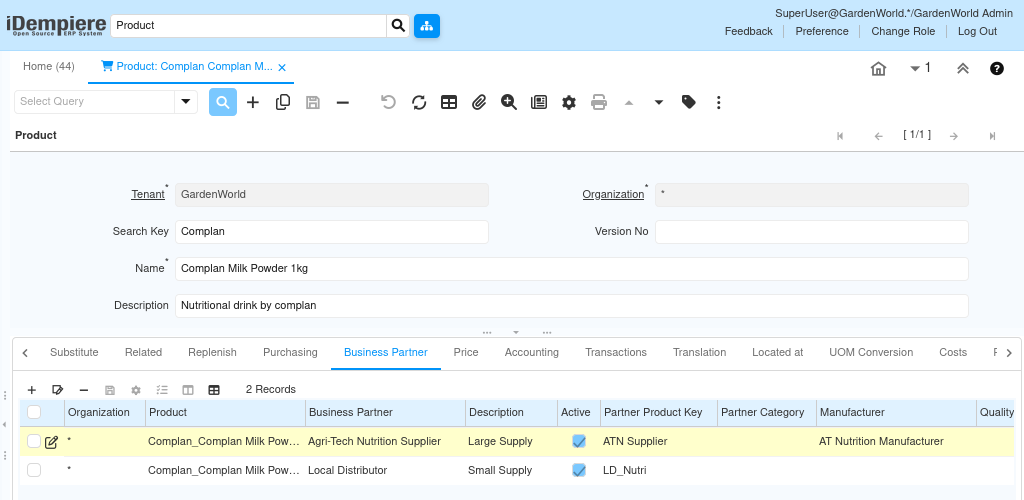
At this stage, the system only understands who can supply the product. No pricing or delivery logic is applied yet.
Vendor Detail (Purchase) Configuration
Vendor-specific purchasing behavior is defined in Vendor Details (Product PO).
This configuration tells the system how each vendor supplies the product.
Important purchasing attributes maintained here include:
- PO Price and historical prices
- Currency and UOM
- Minimum Order Quantity
- Order Pack Quantity
- Promised Delivery Time
- Quality Rating
- Cost per Order
- Current vendor preference
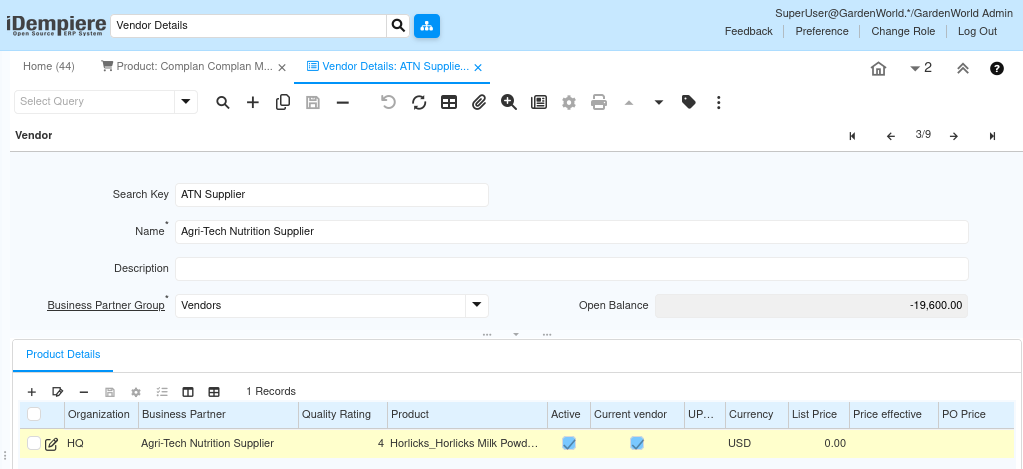
Because this data is vendor-specific, the system can later show accurate comparisons instead of averages or assumptions.
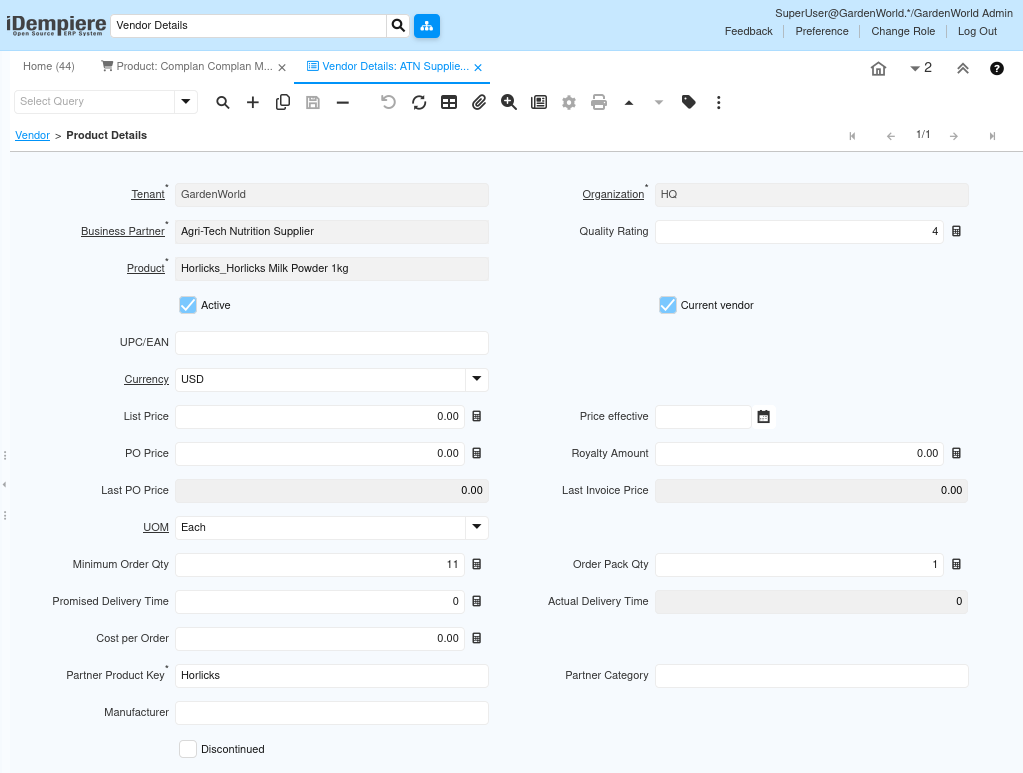
Only vendors with valid and active purchasing data are considered during vendor selection
Vendor Evaluation View
Vendor selection becomes visible through the Vendor Selection Report.
This report consolidates all vendor data for a product into a single comparison view.
It allows procurement users to clearly review:
- available suppliers,
- price differences,
- delivery expectations,
- quality indicators,
- preferred vendor flags.
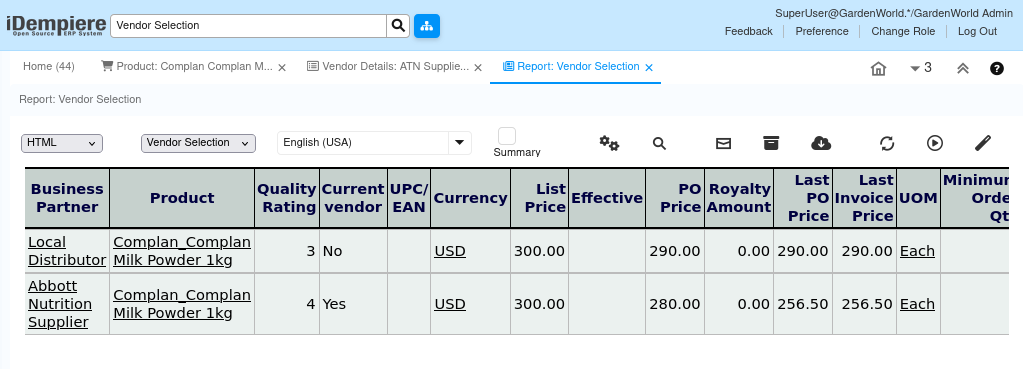
The report does not make decisions automatically. It presents accurate, structured information to support human judgement.
Purchase Order Interaction
When a purchase order is created, iDempiere does not automatically pick the “best” vendor.
Instead, it uses vendor selection data to support the user.
If a current vendor is defined, the system may default to that supplier.
Prices, UOM, and ordering rules are pulled automatically from vendor configuration.
However, the user can still choose another vendor if business conditions require it.
This approach keeps purchasing flexible while preventing data entry errors.
Why Vendor Selection Is Manual by Design
Vendor selection is intentionally not automatic.
Real-world purchasing decisions depend on more than price alone.
Availability, reliability, relationship strength, and urgency often matter more than the lowest cost. iDempiere provides the full picture but leaves the final decision with the user. This avoids incorrect automation and ensures accountability in procurement.
Purpose
Vendor selection exists to handle real procurement complexity.
The same product may be cheaper from one supplier, faster from another, or more reliable from a third. Fixing one vendor permanently limits decision-making and increases risk.
By separating vendor intelligence from transactions, iDempiere ensures purchasing decisions are based on current, comparable data rather than assumptions.
Practical Use Cases
Vendor selection is especially useful when:
- multiple suppliers exist for the same product,
- Prices vary frequently between vendors,
- Delivery timelines affect production or sales,
- Quality differs by supplier.
- Procurement teams need visibility before committing.
It supports informed purchasing without complicating daily operations.
Key Benefits
- Flexible sourcing without changing product setup
- Clear supplier comparison in a single view
- Reduced purchasing errors
- Better negotiation leverage using vendor history
- Clean Purchase Orders without extra custom fields
Vendor selection improves decision quality while keeping the transaction flow simple.
Outcome
With vendor selection configured, iDempiere provides a structured and transparent way to evaluate suppliers before purchasing. Procurement teams gain control and clarity, while transactions remain clean, auditable, and aligned with real business needs.
Vendor selection turns supplier data into actionable insight exactly when it matters.