How RFQ Response Works in iDempiere
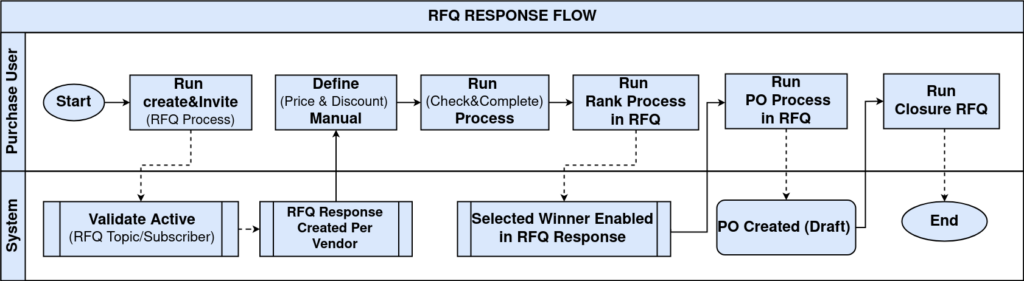
An RFQ response represents a supplier’s formal reply to an RFQ in iDempiere. It captures pricing, quantities, and delivery terms for comparison. Responses are system-generated for invited vendors and hold commercial data only, without impacting inventory or accounting until selection.
Process Flow Diagram
RFQ Response Header (Supplier Commitment Layer)
The response header defines the supplier-level intent and overall commercial context.
It links the response to:
- The original RFQ
- The Business Partner (Vendor) and Location
- The response currency and dates
Key behaviors:
- The response date controls deadline compliance.
- Self-service allows vendors to submit or update responses directly.
- Selected winner is not evaluative by itself; it becomes meaningful only after ranking or manual selection.
- No accounting or stock impact occurs at this stage.

Response Lines (Product-Level Offer Layer)
Each response line corresponds to one RFQ line (product or service requested).
This level defines:
- What item the vendor is responding to
- Delivery expectations (work start, delivery days, completion)
- Descriptive clarifications or commercial notes
Important logic:
- Multiple response lines can exist per RFQ response.
- Lines remain independent, allowing partial wins across suppliers.

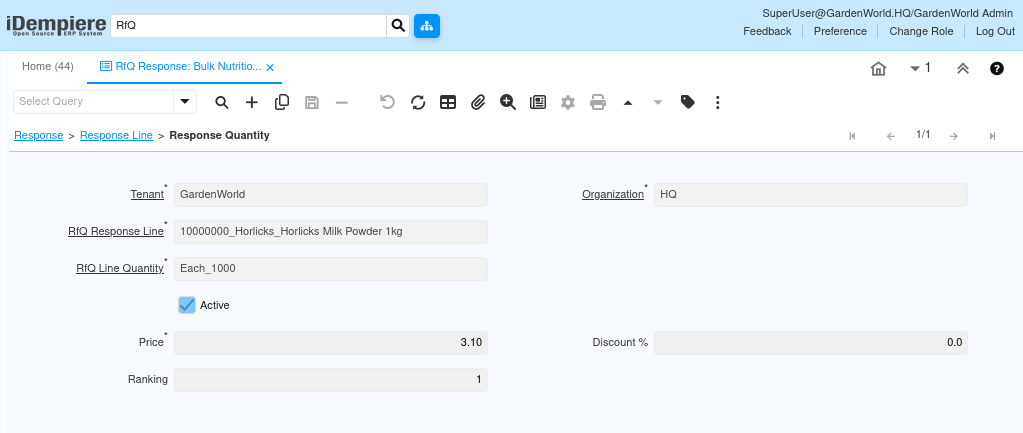
Response Quantity (Price & Comparison Layer)
The response quantity sub-tab captures pricing per quantity break.
It enables:
- Quoting different prices for different quantities
- Applying discounts
- Automatic ranking based on price or configured criteria
Key fields:
- Price – vendor’s quoted unit price
- Discount % – commercial adjustment
- Ranking – system/manual score for comparison
This layer is critical for competitive analysis.
Purpose, Use Cases, and Outcome
RFQ responses exist to standardize supplier comparisons while keeping procurement flexible.
They are used when:
- Multiple vendors quote the same requirement
- Price, delivery, and terms must be compared objectively
- Procurement wants auditability before converting to orders
Final outcomes:
- Transparent supplier comparison
- Controlled vendor selection
- Clean transition to Purchase Order for the winning response
RFQ response management ensures that purchasing decisions are data-driven, traceable, and operationally safe.