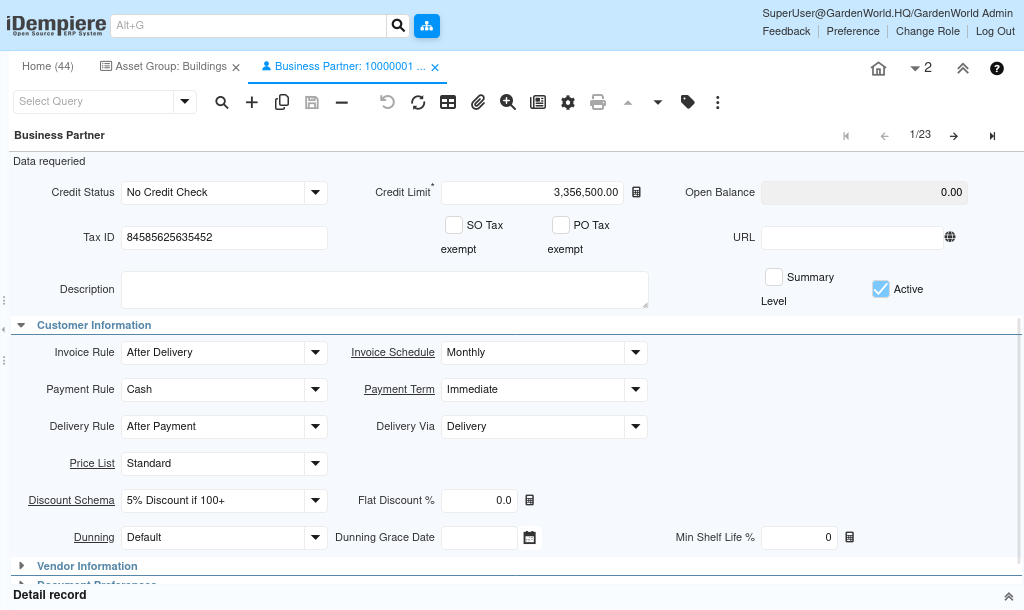
How customer sales configuration works in iDempiere
Customer sales configuration defines commercial, logistical, and financial rules for a Business Partner, controlling pricing, billing, delivery, and payments. These settings auto-populate Sales Orders to ensure consistency and reduce manual effort.
Process Flow

Price List for Controlling Selling Prices
The price list assigned to a customer determines the product prices, currency, and whether tax is included. When a Sales Order is created, iDempiere immediately uses this price list to set item prices, ensuring accuracy and consistency across all transactions.
Payment Rule and Payment Term
Payment rules define the customer’s method of payment, while payment terms control when the invoice becomes due. These settings help enforce credit policies and ensure that receivables are collected according to agreed timelines.
- Payment Rule (Cash, On Credit, Direct Debit, etc.)
- Payment Term (Immediate, Net 30, Installments, etc.)
Together, they define the financial behavior expected from the customer.
Invoice Rule and Invoice Schedule
Invoicing behavior determines when the customer is billed. Some customers require immediate invoicing, while others prefer consolidated monthly invoices. An Invoice Schedule helps automate periodic billing cycles where multiple deliveries or orders are grouped into a single invoice.
Delivery Rule and Delivery Via
Delivery settings control how and when goods are shipped. For some customers, partial delivery is acceptable; others require complete shipment only when all products are available. Delivery Via defines the transportation method, such as pickup, standard shipment, or drop shipment.
- Delivery Rule (Complete Order, Complete Lines, Availability, etc.)
- Delivery Via (Pickup, Shipment, Drop Shipment)
These settings guide warehouse and logistics teams.
Discount Schema and Flat Discount
Discount configuration can be simple or advanced. A flat percentage discount applies uniformly across all products, while a discount schema can define complex rules based on quantity, product category, or price tiers. This allows organizations to model almost any commercial agreement.