How Customer Requests and Orders Work in iDempiere
Customer Requests and Orders represent the operational side of customer management in iDempiere. Orders drive sales and fulfillment, while Requests track issues and service needs, ensuring customer problems are visible, assigned, and resolved within the same system.
Customer Requests — Service and Support Workflow
Customer Requests are used to log, track, and resolve customer-initiated issues such as complaints, inquiries, returns, or service follow-ups. Each request is a controlled document with priority, ownership, and lifecycle tracking.
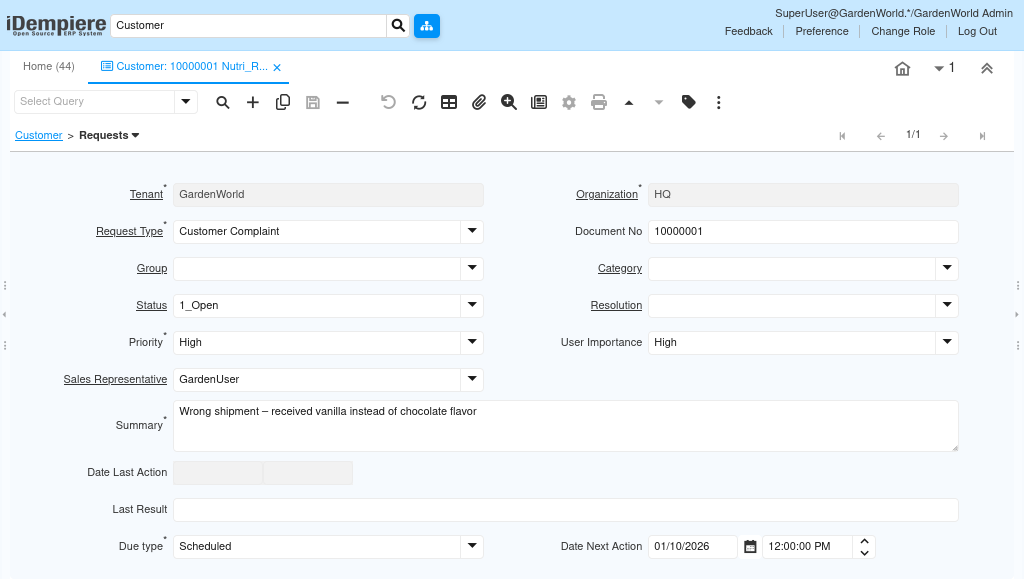
When a request is created, it is linked to the Customer, optionally linked to an Order, and assigned to a responsible Sales Representative or Support User. This ensures that customer issues are not lost in emails or calls and remain auditable.
Key configuration and transactional behavior:
- Request Type defines the nature of the issue (e.g., Customer Complaint, Inquiry, Service Request).
- Status controls the lifecycle (Open, In Progress, Closed).
- Priority and User Importance drive urgency and handling order.
- Summary captures the customer’s issue in clear business language.
- Date Next Action enforces follow-ups and SLA discipline.
Requests do not impact accounting directly, but they protect revenue and customer trust by ensuring issues are resolved promptly and transparently.
Typical Use Cases
- Wrong product delivered
- Product quality complaints
- Delivery delays
- Post-sale support or clarification
- Customer feedback tracking
Customer Orders — Sales Execution and Fulfillment
Customer Orders represent confirmed sales transactions and are the foundation for delivery, invoicing, inventory movement, and revenue recognition.
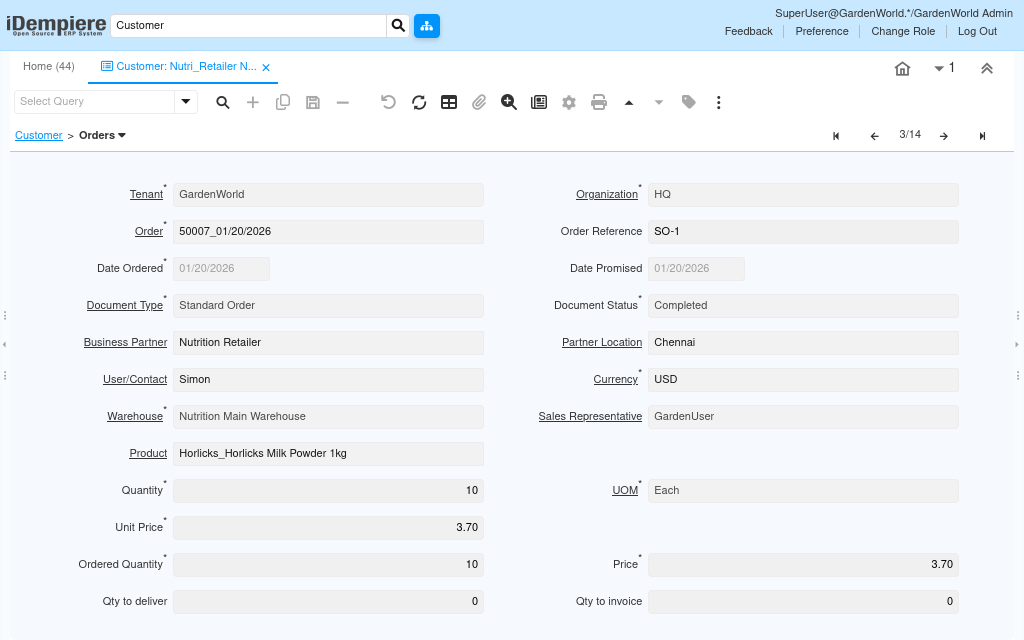
An Order is created either directly or derived from a Sales Opportunity or Quotation. Once completed, it becomes a legally and operationally binding document.
Order behavior is tightly integrated with multiple modules:
- Inventory (reservation and shipment)
- Pricing (price lists, contract prices, discounts)
- Logistics (warehouse and shipper)
- Accounting (invoicing and receivables)
Core transactional structure:
- Business Partner & Location determine delivery, invoicing, and tax behavior.
- Warehouse controls inventory sourcing.
- Product, Quantity, and Price define commercial terms.
- Document Status controls lifecycle (Draft → Completed).
Order Line Processing and Fulfillment Logic
Order Lines define what is sold and how much, and they drive downstream logistics.
Each line interacts with inventory and pricing rules:
- Quantity Ordered triggers stock availability checks.
- Unit Price is derived from price list or contract price.
- Shipper determines freight handling and delivery method.
- Delivered Quantity and Invoiced Quantity track fulfillment progress.
If inventory is insufficient, the system warns the user but still allows controlled processing based on business policy.
Relationship Between Orders and Requests
Orders and Requests are intentionally loosely coupled but contextually linked.
- Requests can reference Orders to provide context.
- Orders remain commercially valid regardless of open Requests.
- Support teams can resolve issues without altering financial documents unless required.
This separation ensures financial integrity while still allowing operational flexibility.
Outcomes and Operational Benefits
This combined setup delivers clear advantages:
- Centralized customer issue tracking with accountability
- Clean separation between sales transactions and support workflows
- Full audit trail of customer interactions
- Faster issue resolution and improved customer satisfaction
- Reliable sales, delivery, and invoicing control
Resulting System Behavior
Once configured and used correctly:
- Orders drive revenue, inventory, and accounting automatically
- Requests ensure customer issues are visible and actionable
- Sales, logistics, and support teams work from the same data
- Customer history remains complete and traceable
This structure allows iDempiere to function not just as an ERP, but as a customer-centric operational system.