How to view GST Total Customer Sales Summary Report in Adempiere Retail
A “GST Total Customer Sales Summary Report” is a document or summary that provides a detailed breakdown of all customer sales transactions, including the applicable Goods and Services Tax (GST).
User Access
Who Can Access
- Admin
- Back Office
- Purchase Manager
- Manager
What User Can Do
- Review Sales Data
- Verify Total Sales
- Check GST Compliance
- Generate Reports for Tax Filing
- Prepare Tax Returns
- Make Financial Decisions
- Improve Sales and Marketing Strategy
- Export/Share the Report
- Track Refunds or Returns
Prerequisite Activities
- Maintain Accurate Sales Records
- Ensure Proper GST Classification
- Update Accounting or ERP Software
- Verify Customer Details
- Set Reporting Period
Business Rules
- Invoice Data
- Tax Calculation
- Reporting Period
- Customer Classification
User Interface
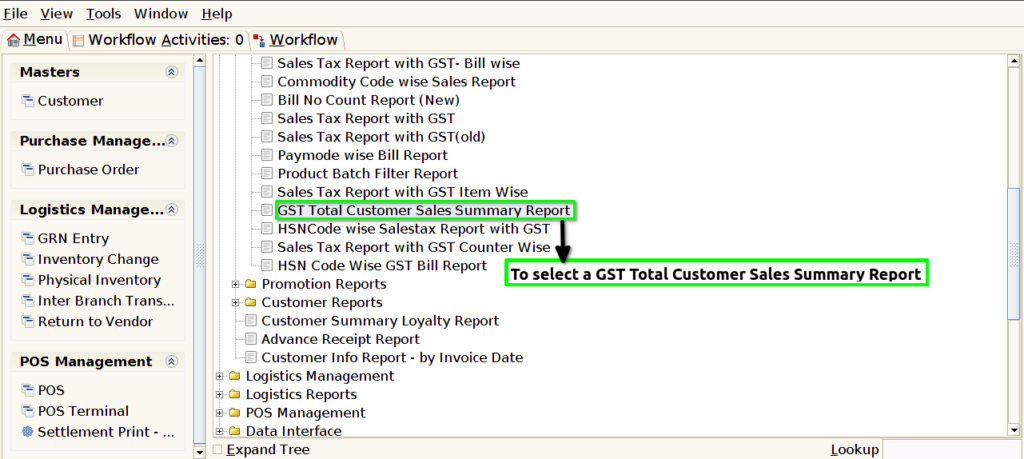
STEP 1: To select a GST Total Customer Sales Summary Report.
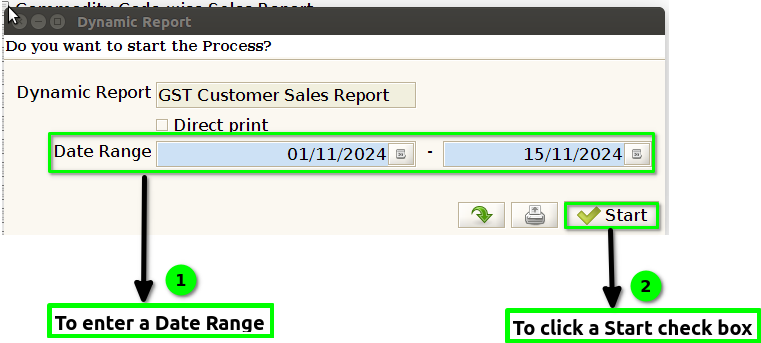
STEP 2: To enter a date Range in this field is mandatory.Then to click a start check box and to run the process.
STEP 3: Once to complete the process and to show the report based on the given data.
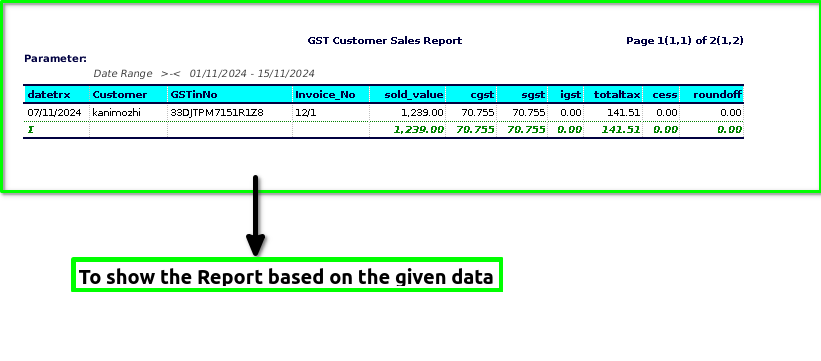
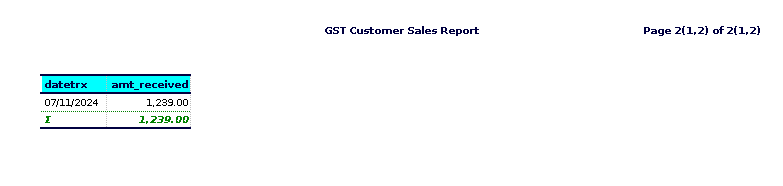
STEP 4: DateTRX– is a tool or service designed to help users manage, track, and analyze their romantic or dating experiences. It is generally used to log and organize various details about dates, relationships, and interactions, providing users with insights into their dating patterns or improving their social interactions.
Customer– is an individual or organization that purchases goods or services from a business or seller.
GSTIN– stands for Goods and Services Tax Identification Number. It is a unique identification number that is assigned to businesses and entities registered under the Goods and Services Tax (GST) system in India. The GSTIN is used to track and manage tax compliance and transactions under GST.
Invoice number-is a unique identifier assigned to a specific invoice. It serves as a reference number for both the buyer and the seller to track and manage transactions. The invoice number helps ensure that invoices are processed, paid, and recorded correctly.
Sold value-refers to the total amount of money received from a sale or transaction. It typically includes the price of the goods or services sold, excluding any discounts, taxes, or additional fees unless specified otherwise.
CGST -(Central Goods and Services Tax)-This is the tax collected by the central government on the intra-state supply of goods and services (within the same state).
SGST– (State Goods and Services Tax)-This is the tax collected by the state government on the intra-state supply of goods and services (within the same state).
IGST -(Integrated Goods and Services Tax)-This is the tax levied on inter-state transactions, i.e., when goods or services are supplied from one state to another.
Total tax– generally refers to the total amount of taxes a person, business, or organization is required to pay to government authorities over a given period, such as a year. This can include a variety of taxes depending on the tax system in a particular country or jurisdiction.
Cess-is a form of tax or levy imposed by governments to fund specific projects or activities, typically in addition to regular taxes. It is usually temporary or dedicated to a particular cause, such as infrastructure, education, health, or disaster relief.
Rounding off-is the process of adjusting a number to a nearby, simpler value, usually for ease of calculation or to express it more concisely. The idea is to reduce the complexity of a number while keeping it close to the original value.
Amount received-generally refers to the total sum of money or value that is actually obtained in a transaction, after all relevant deductions or adjustments (like taxes, fees, or discounts) have been applied.