How to view Unpaid Order Details (Today) Report in Adempiere Retail
A report or list showing all orders placed today for which payment has not yet been received.
User Access
Who Can Access
- Admin
- Back Office
- Purchase Manager
- Manager
What User Can Do
- View
- Sort or filter
- Download or print
- Update payment status
- Export data
Pre-Requisite Activities
- Order Entry
- Payment Tracking Setup
- Unpaid Status
- System Date Sync & Data Validation
Business Rules
- Order Inclusion
- Unpaid Definition
- Payment Status Update
User Interface
STEP 1: To select a Unpaid Order Details(Today).

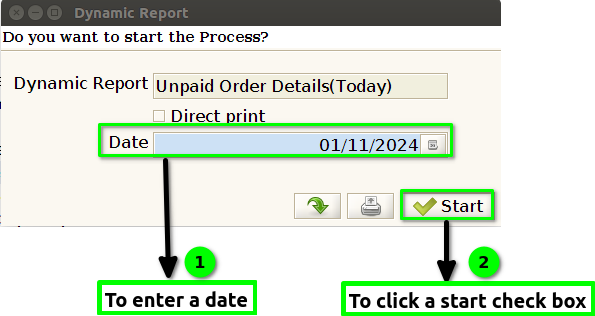
STEP 2: To enter a date range in this field is mandatory then to click the start check box to run the process.
STEP 3: Once to complete the process to show the report based on the given data.
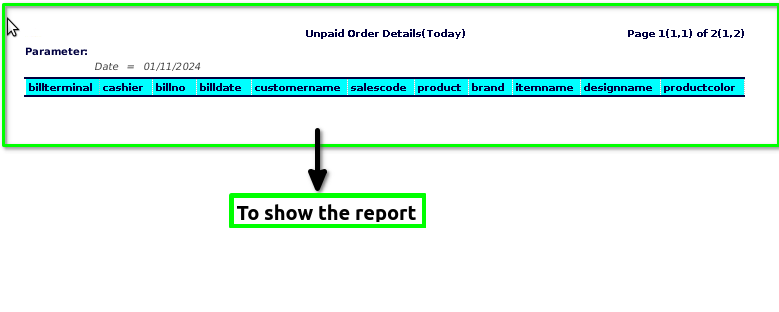
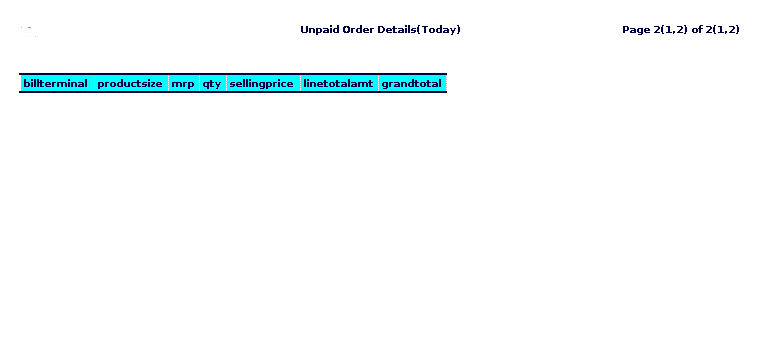
STEP 4: Bill terminal – generally refers to a type of payment terminal used for processing payments and handling financial transactions, such as paying for bills or purchases. It is commonly found in retail, service, or utility sectors, where it allows customers to settle their outstanding bills by using various payment methods, including cash, debit/credit cards, and digital payments.
Sales representative (sales rep) – is a professional who is responsible for selling products or services to customers, typically on behalf of a company or organization. Their primary role is to generate sales, build relationships with customers, and promote the company’s offerings to meet the sales targets.
Bill Number is a unique identifier assigned to a specific bill, invoice, or transaction. It is used to track and reference the bill in record-keeping, accounting, and payment systems.
Bill Date refers to the date when the bill was issued or created. This is important for accounting, as it helps determine the due date for payment, the time frame for transactions, and the period in which goods or services were provided.
Customer name– refers to the name of an individual or organization who purchases or uses a product or service.
Grand total – refers to the sum of all values or amounts combined in a list, table, or data set. It represents the overall total or final sum when you add up all the individual totals or values within a specific category or across multiple categories.
Cashier– is a person who handles financial transactions in various settings, such as retail stores, restaurants, banks, and other businesses.Processing Payments-Cashiers accept payments from customers, which can be in the form of cash, credit/debit cards, mobile payments, or checks.Providing Receipts: After completing the transaction, cashiers typically issue a receipt to the customer as proof of purchase.
Sales code – typically refers to a unique identifier or a system used within a business or organization to categories, track, and manage sales transactions, products, services, or promotions.
Brand– A brand is created through design, packaging, and advertising elements that distinguish the product from its competitors.
Product – is generally something that has been made or created for consumption, use, or further transformation in various contexts.
Item name – typically refers to the specific name or description of a product, service, or charge that is listed on the report. The unpaid report usually details outstanding payments, often for an invoice or account, and includes various items for which payment is still due.
Design Name -This could be the name given to a specific design or product. For example, a designer might create a new line of clothing, and the design or collection might have a unique name, such as “Spring/Summer 2024 Collection.
Product Color – Refers to the actual color or shade of the product. – It is used to differentiate between variations of a product.
Product Size – Refers to the dimensions or measurements of a product. This can be physical size (such as length, width, height) or capacity (like volume or weight). – Size is particularly important for clothing, footwear, furniture, electronics, etc. – For clothing, sizes may be labeled as Small, Medium, Large, or specific measurements like 32-inch waist, or shoe sizes like 8, 9, 10.
MRP– is a system for calculating the materials and components needed to manufacture a product.
Selling price -is the price that a customer pays to purchase a product or a commodity.
Quantity – refers to the amount or number of something. It is a measurable property that can be expressed in terms of size, number, volume, weight, or other measurable units.
Line total amount– typically refers to the total value of a specific line item on an invoice, order, or financial statement. It is calculated by multiplying the quantity of the item by its unit price, and sometimes includes additional calculations for taxes, discounts, or other adjustments.
Grand total– refers to the final sum or overall amount that results from adding together various individual totals or amounts in a given set of data, transactions, or calculations. It is typically the final figure that represents the sum of all items, costs, or values combined